
Braids, buns, and ponytails are the backbone of children’s hair, but the details change every season. Curtain bangs and soft face-framing layers are replacing heavy side-swept fringes, and lived-in color means fewer visits to the salon for root touch-ups.
This collection of 33 Simple Children Hairstyles covers everything from five-minute school-morning styles to weekend braids that hold for days. It works for fine hair that falls flat, thick coily hair that needs protective styling, and every texture in between. You will find low-upkeep cuts, salon-made braids, and styles that bridge the gap between cute and practical.
Intricate Braids With Heart Shapes
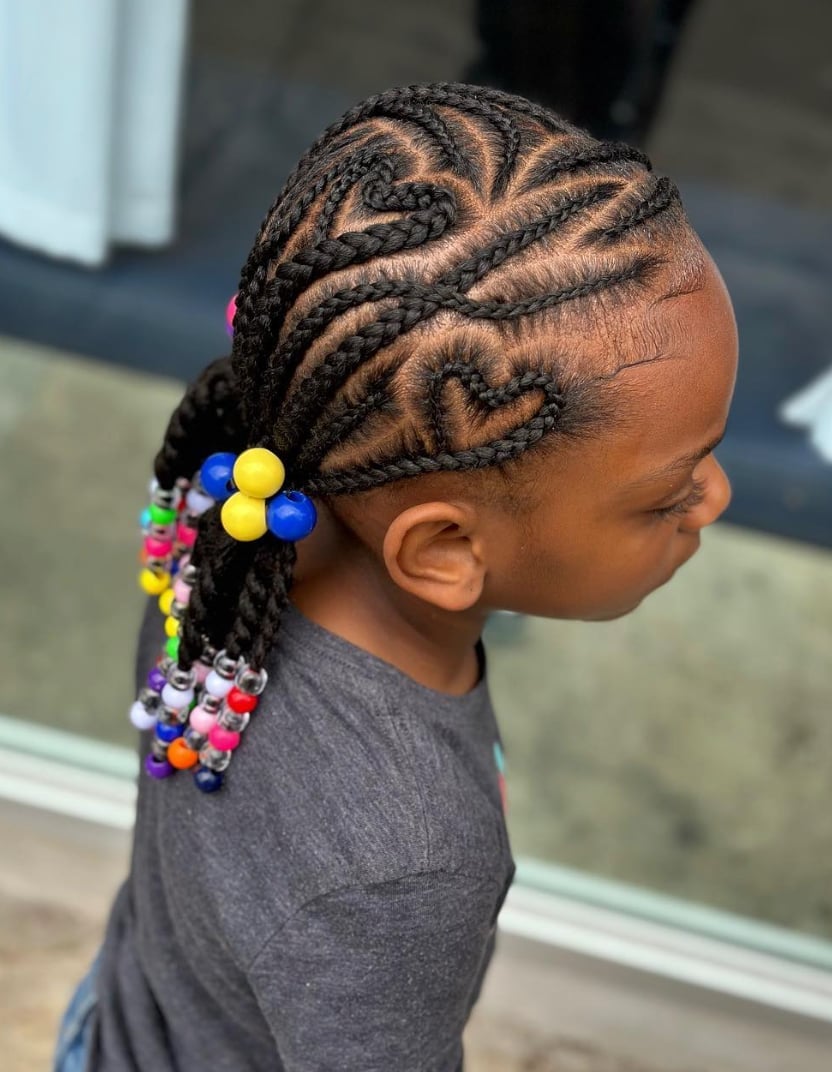
The precision of those heart shapes requires a steady hand to map the pattern before a single braid starts. On thick, coily hair cut to mid-back length, the design reads clearly because the texture gives the braids grip, so the hearts hold their outline instead of blurring into the scalp. A middle parting keeps the geometry symmetrical, which matters more than you think when the pattern is this detailed.
This is a salon build, so budget real time in the chair. Ask your stylist for: heart-shaped braids into pigtails with beads. The beads add weight to the ends, which helps the pigtails hang rather than frizz, but they also mean regular touch-ups to keep the braid definition sharp, especially around the hairline where little hands tend to explore.
Long Dark Brown Hair With Heart Braids
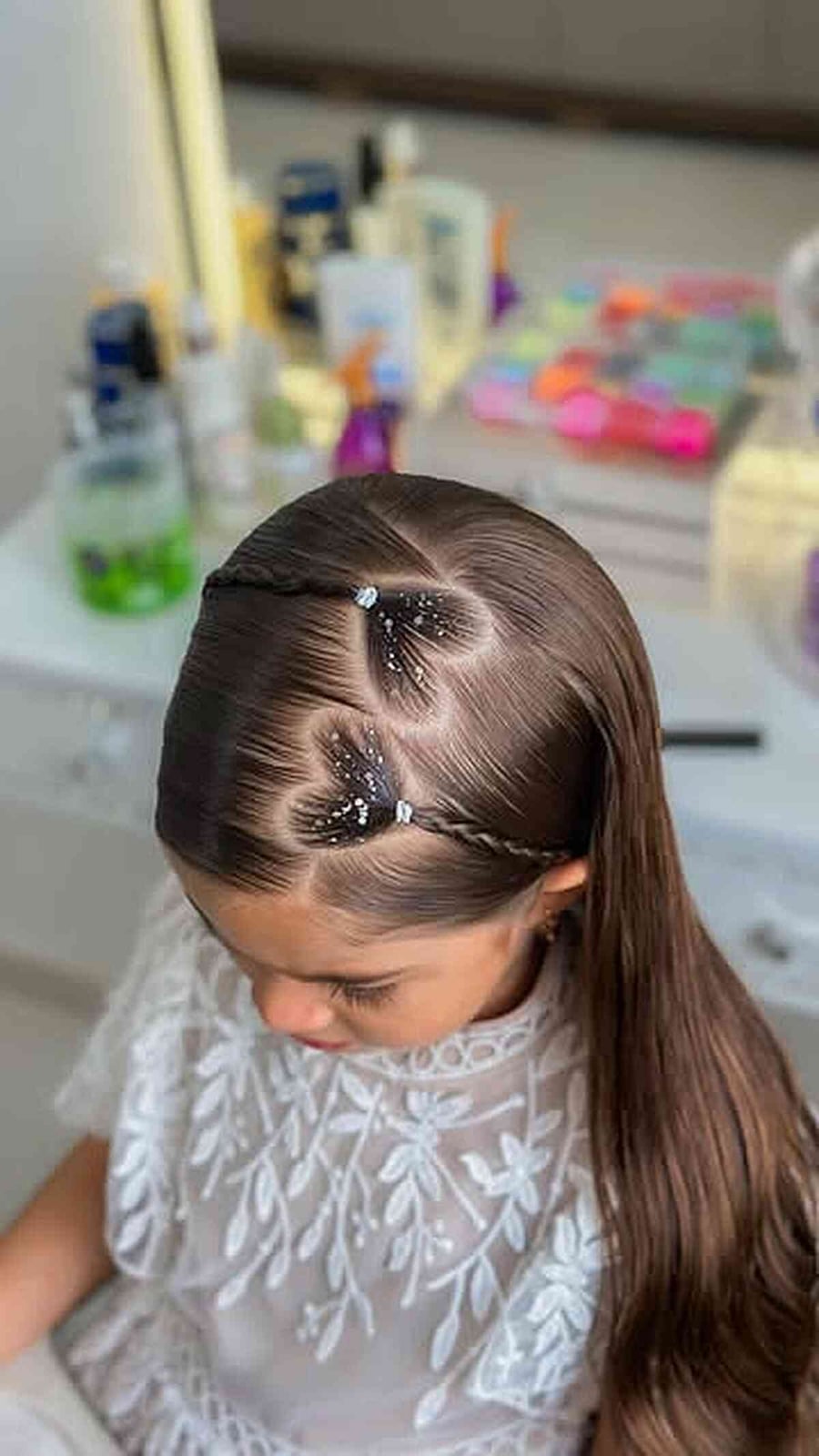
Straight hair holds these braids differently than coily texture does: the smooth strands show every crossover clearly, so the hearts look crisp rather than chunky. That same smoothness means the braids can slip, so they need to be worked snug against the head from the start. A middle part keeps the two hearts balanced on either side. This style suits anyone with long, straight hair who wants a touch of sparkle without committing to an all-over updo. Ask your stylist for: heart-shaped braids at the front, rest worn down. The glitter is the detail that makes it feel like an occasion, but it also means gentle detangling and a light mist of hairspray to keep the sparkle where it belongs.
Chin Length Bob With Side Braid Accent
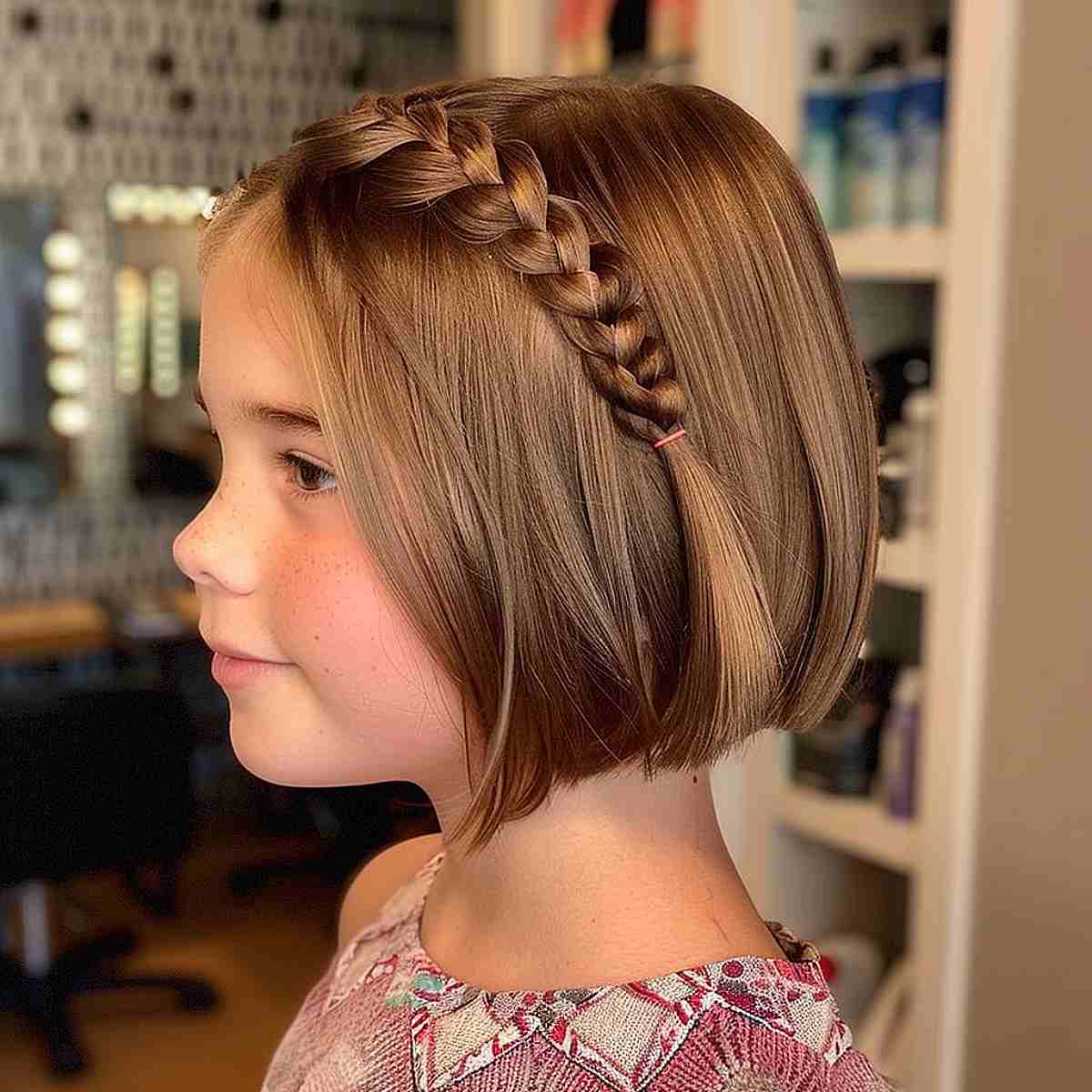
Can a bob handle a braid without turning fussy? This one does, because the single braid runs along the side of a chin-length cut and tucks into the line of the bob, so it reads as an accent. The light brown hair with subtle highlights is kept straight, which keeps the whole thing sleek and school-day easy. A braid on a bob works best on fine to medium density hair; too thick and the braid overwhelms the short shape. Ask your stylist for: chin-length bob with one side braid. To recreate it at home, part the hair to one side, braid a small section from the temple back to the ear, and secure with a tiny elastic. A light styling cream adds shine to the straight ends, and a trim every six weeks keeps the bob blunt.
Blonde Pigtails With Braids and Ribbons
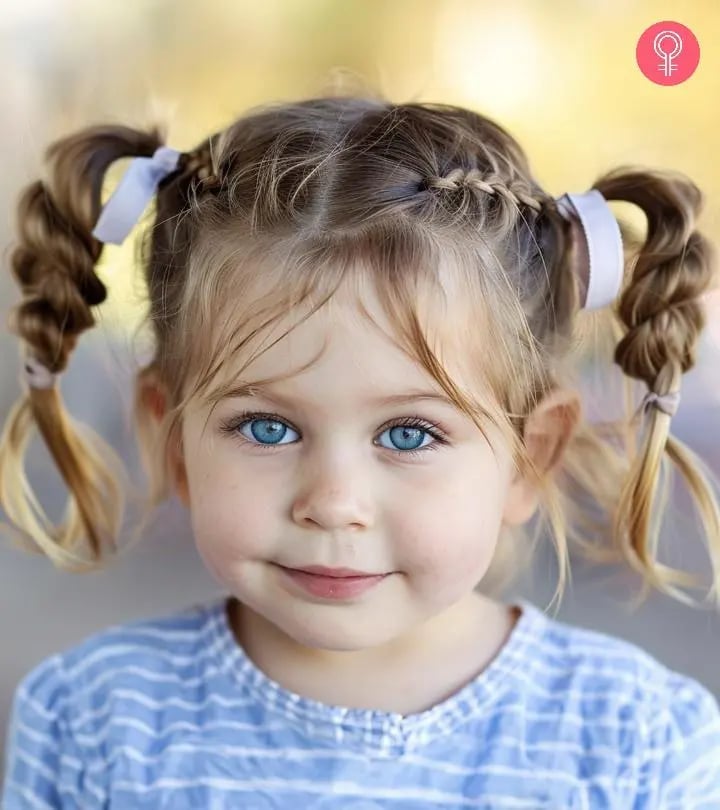
There is a trick to braiding fine, wavy hair into pigtails that look polished: leave the face-framing strands loose. Here, the blonde waves are split with a middle part, braided into two pigtails that end around the collarbone, and the pieces around the face stay free to soften the whole thing. White ribbons tied at the top of each pigtail add the finishing touch, and they also hide the elastic, which is a win on its own. On fine texture, braid snugly but not tight, because loose strands will escape anyway and that is exactly what you want. Ask your stylist for: braided pigtails with loose face-framing pieces and ribbons. A spritz of texturizing spray on the loose strands gives them a softer, more blended finish, and the braids can be redone daily in about ten minutes.
Braided Crown With Loose Waves
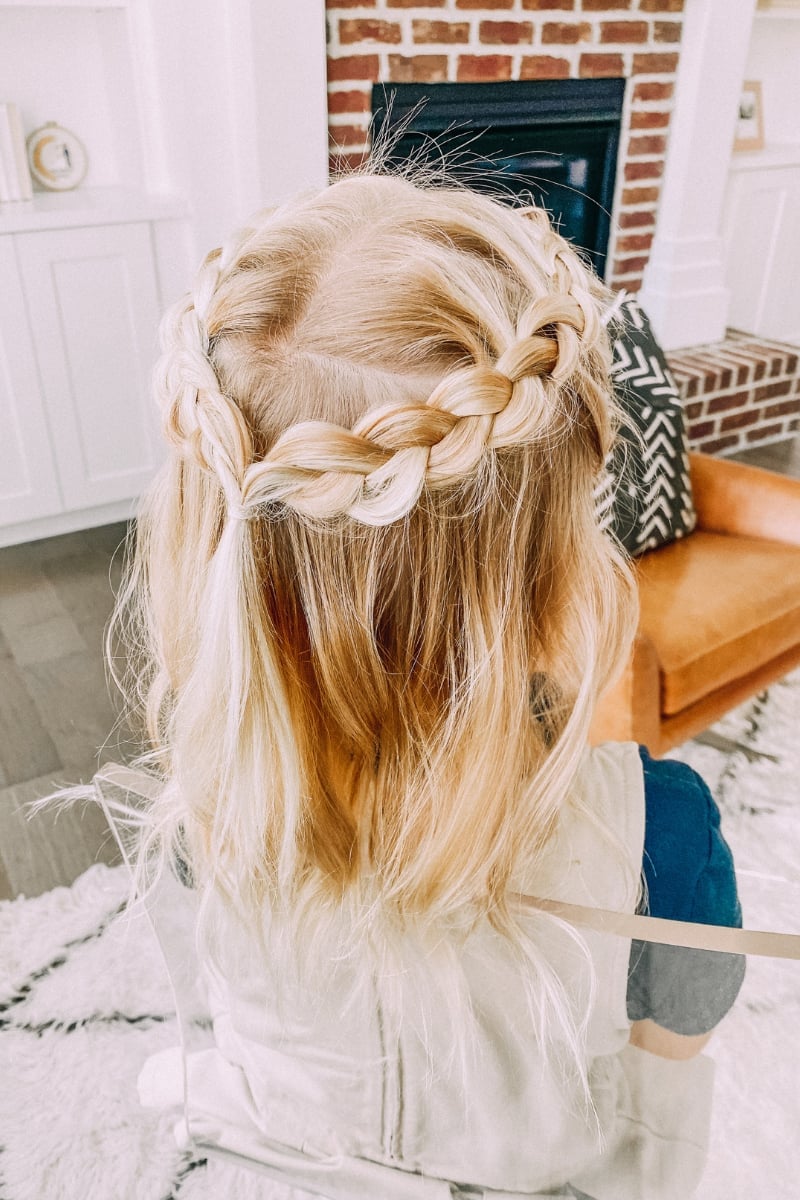
A crown braid is a different animal from a standard halo braid: it sits closer to the scalp, like a circlet, rather than wrapping loosely around the head. On fine, wavy ash blonde hair that reaches the collarbone, the braid reads as delicate instead of heavy, and the loose waves underneath keep the style from feeling too formal. The braid starts at one temple and meets at the nape, with the middle part keeping the crown even on both sides. It holds well for a full day, but the waves can soften and drop by evening, so a texturizing spray at the roots helps them keep their bend. Ask your stylist for: braided crown with loose waves. The honest drawback is the takedown: fine hair can pick up tangles where the braid crosses the waves, so detangle gently with your fingers before reaching for a brush.
Space Buns With Braids and Beads
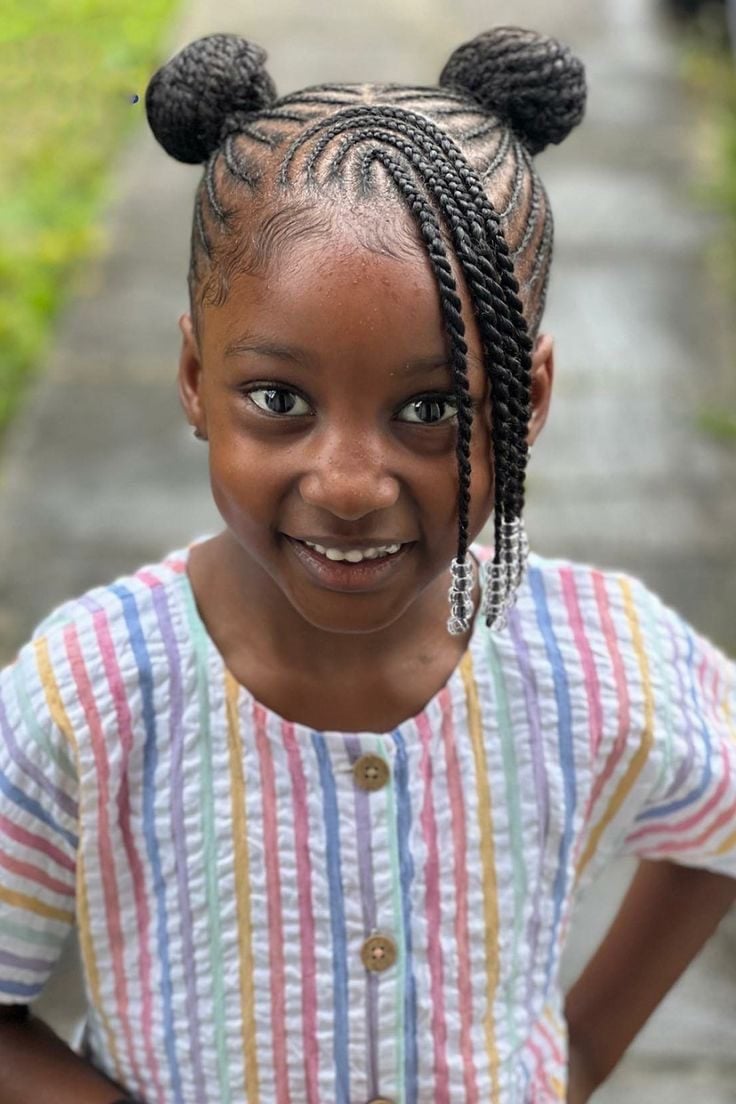
Can you pull off space buns without them looking like a last-minute scramble? Thick, coily black hair is sectioned into two neat buns, with intricate braids feeding into each and a single beaded strand falling forward. The style works best on short to medium coily hair and requires a salon visit to get the parting and braid tension right. Ask your stylist for: space buns with braids and a beaded side strand. A strong hold gel along the hairline keeps flyaways in check, but the real trade-off is time, expect to sit for a couple of hours.
Cornrows to High Buns With Bows
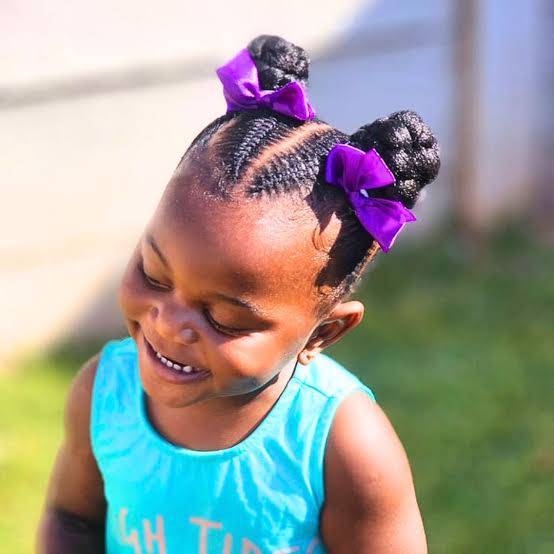
Those purple bows are doing more than just looking cute. Neat cornrows start at the front of a central parting and travel back into two high buns, all on dark, coily, thick hair that reaches mid-back. The design is secure enough for school or sports, and the bows make it feel festive without adding extra styling time. Ask your stylist for: cornrows leading to two high buns with purple bows. Keep the cornroots moisturized with a light oil spray to prevent dryness between washes. A trim every eight weeks keeps the ends tidy and the braids crisp.
Sleek Half-Up Ponytail
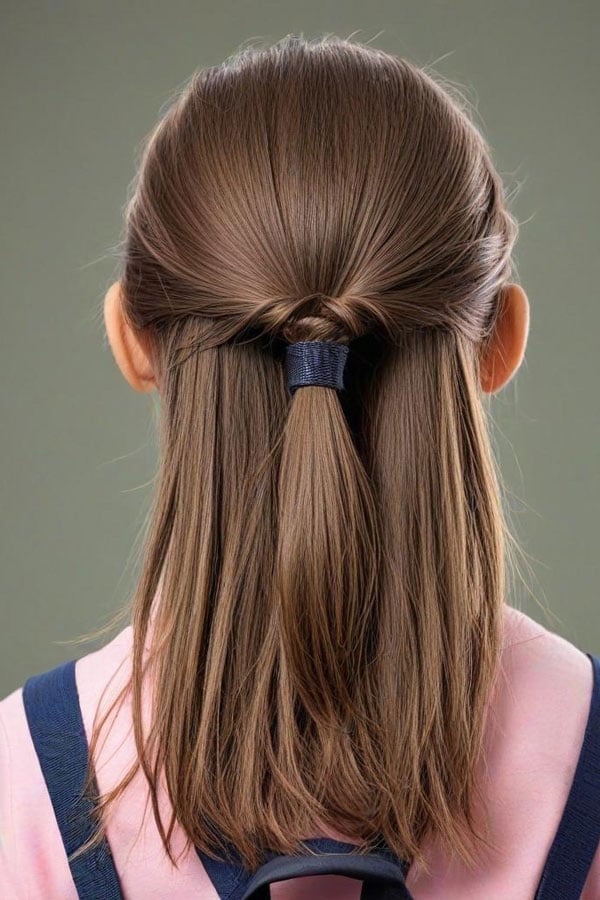
A half-up ponytail with everything else down sounds simple, but the finish is what separates neat from messy. Here, straight brown hair to mid-back is pulled into a sleek half-up section secured with a dark band, with the rest left smooth and straight from a middle part. The look takes about five minutes at home if you start with a blowout. Ask your stylist for: sleek half-up ponytail, rest worn down. A fine-tooth comb and a light spritz of hairspray give that polished finish. For a less formal version, skip the hairspray and let the ends fall naturally.
Box Braids to Curly Pigtails and Buns
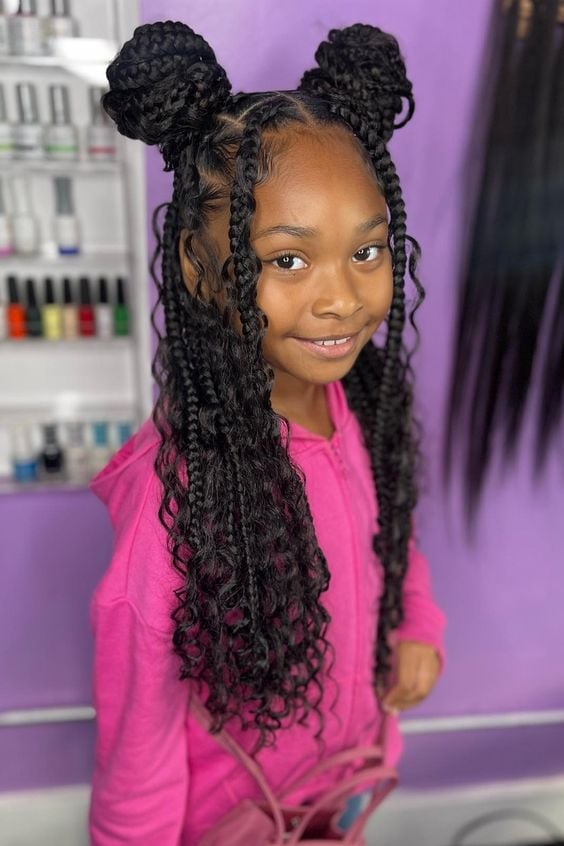
How do you get curly ends on box braids without heat? The answer is a dip in hot water after braiding. Here, thick black hair is parted down the middle and braided into box braids that end in soft curls, with two sections gathered into high space buns at the crown. Baby hairs are smoothed along the hairline with gel. Ask your stylist for: box braids into curly pigtails, styled into two high buns. A curl cream on the ends keeps them defined and stops frizz. The style holds for about two weeks with a satin scarf at night, and a light oil spray on the scalp prevents dryness.
Blonde Shoulder Length Bubble Braids
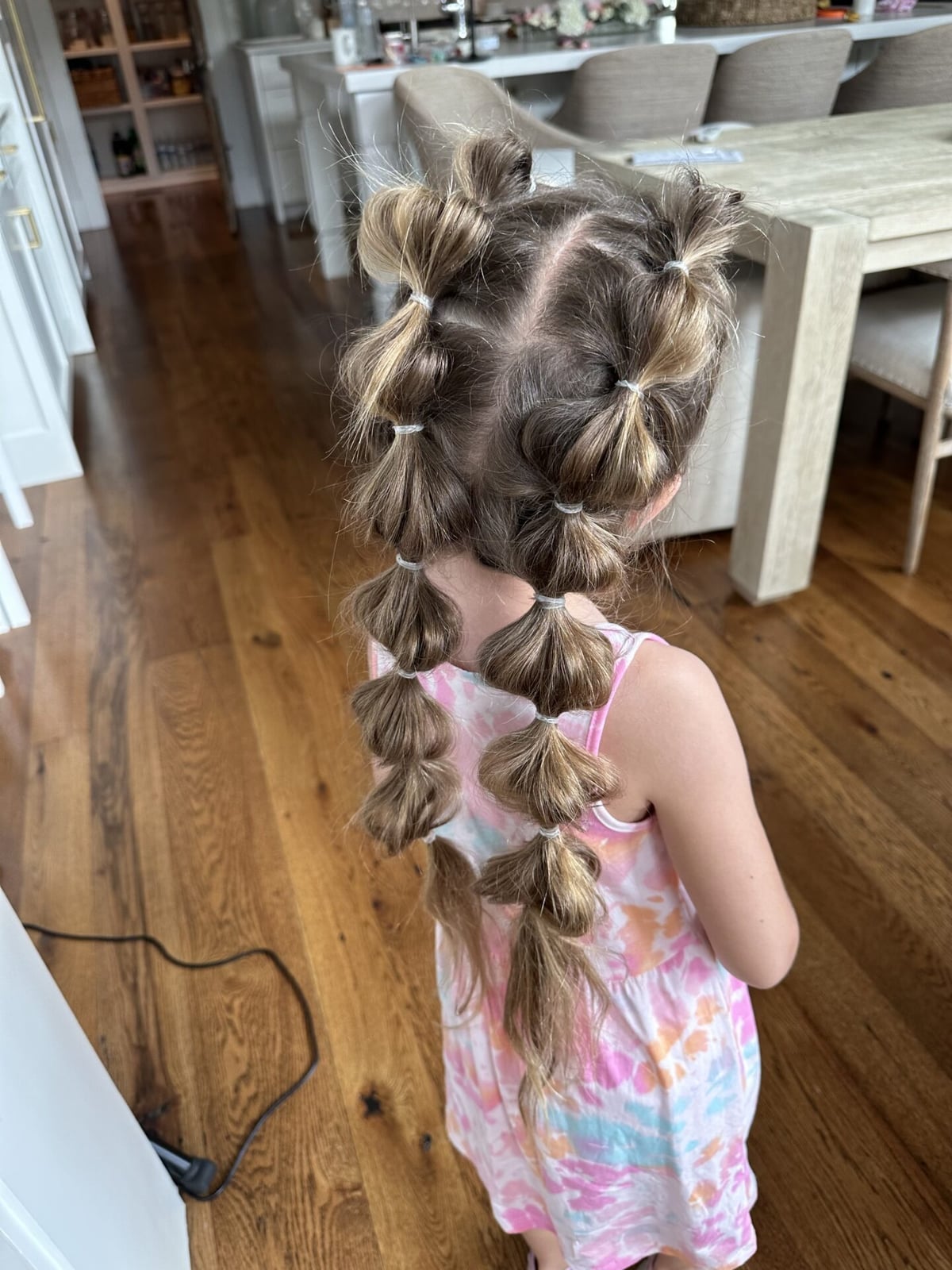
Bubble braids are essentially a low-commitment way to add volume to fine or medium hair. Straight blonde hair at shoulder length is sectioned into multiple bubbles from root to tip, with a middle part and clear elastics keeping the look clean. Ask your stylist for: multiple bubble braids all over. The DIY version takes about 15 minutes, just pull each section gently to puff it out. A texture spray on dry hair before braiding helps the bubbles hold their shape. It stays intact through a school day and comes out with a simple snip of the elastics.
Box Braids With Brown Undertones and Curls
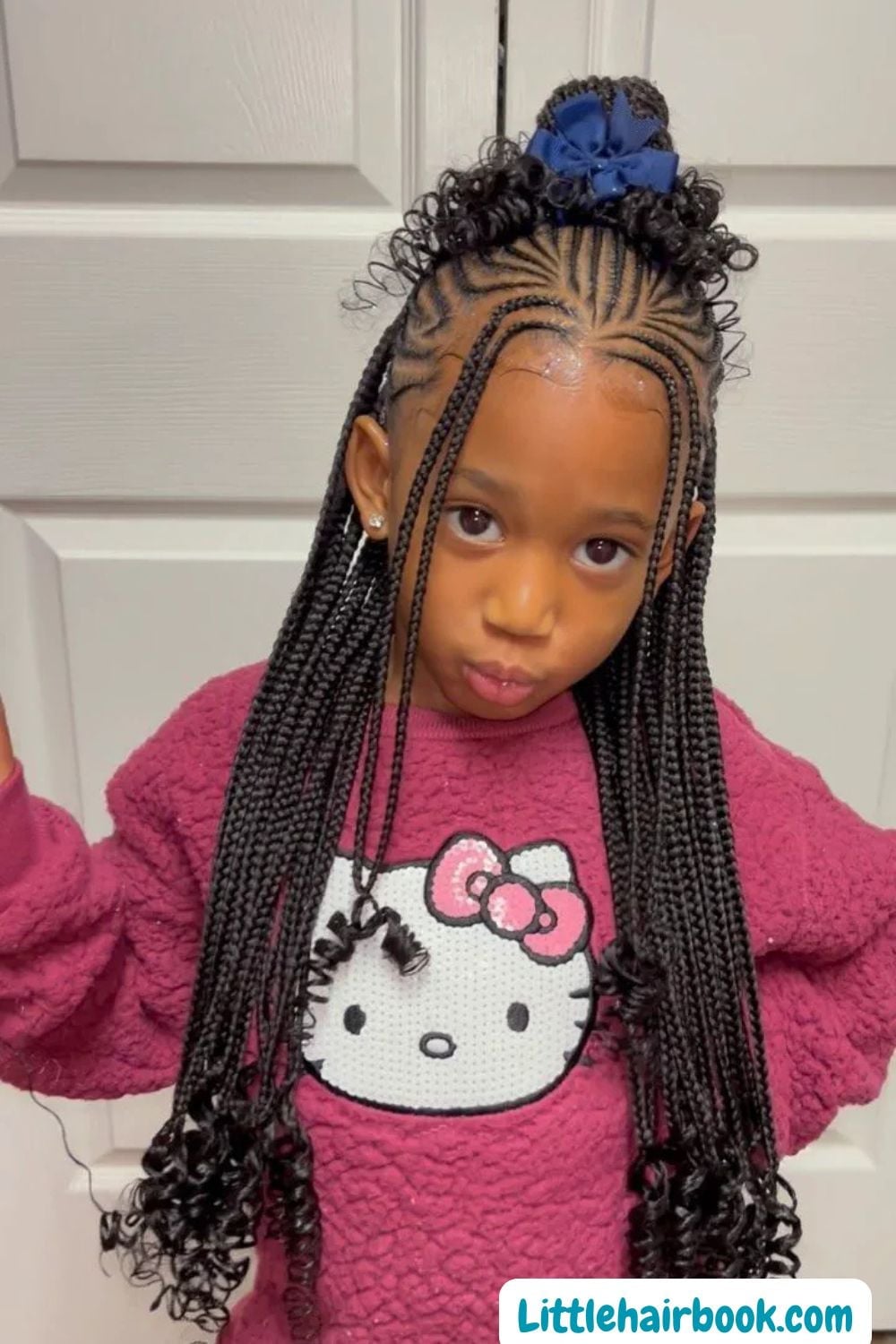
Long box braids with neat cornrows at the parting and curly ends at the bottom need a few extra minutes in the morning to keep looking fresh. This style suits thick, coily hair that is at least mid-back length; the brown undertones add depth without a full color change. Ask your stylist for: box braids with curly ends and cornrow parting. A curl-defining cream on the ends each morning helps them hold their shape, and a blue bow secured with a small elastic adds a clean finishing touch. The real drawback is the time it takes to redo the cornrow base, which usually needs a salon visit every four to six weeks to stay neat at the roots.
Box Braids With Blonde Highlights and Beads
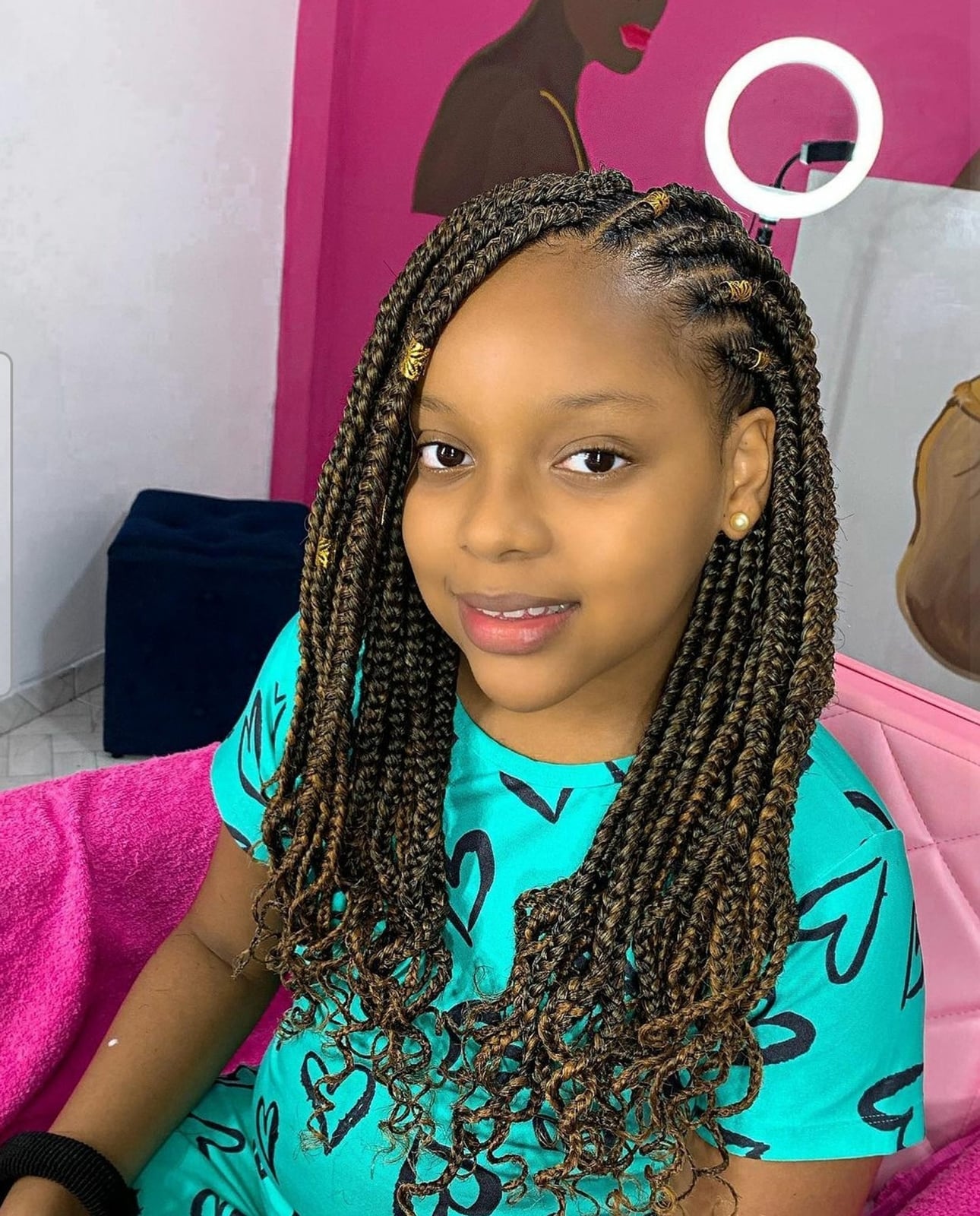
Long box braids with blonde highlights and small decorative beads scattered through the length look detailed, but the beads have a habit of snagging on clothing or falling off mid-week. This style works best on thick, coily hair from mid-back length down; the side part and face-framing pieces keep it from reading as too uniform. Ask your stylist for: box braids with blonde highlights and beads, side part. If you have a child who plays rough or sleeps with a lot of movement, beads are probably one to skip. The highlights will need a toning appointment every six to eight weeks to keep the blonde from pulling brassy against the dark brown base.
Star Braid Pattern Pigtails
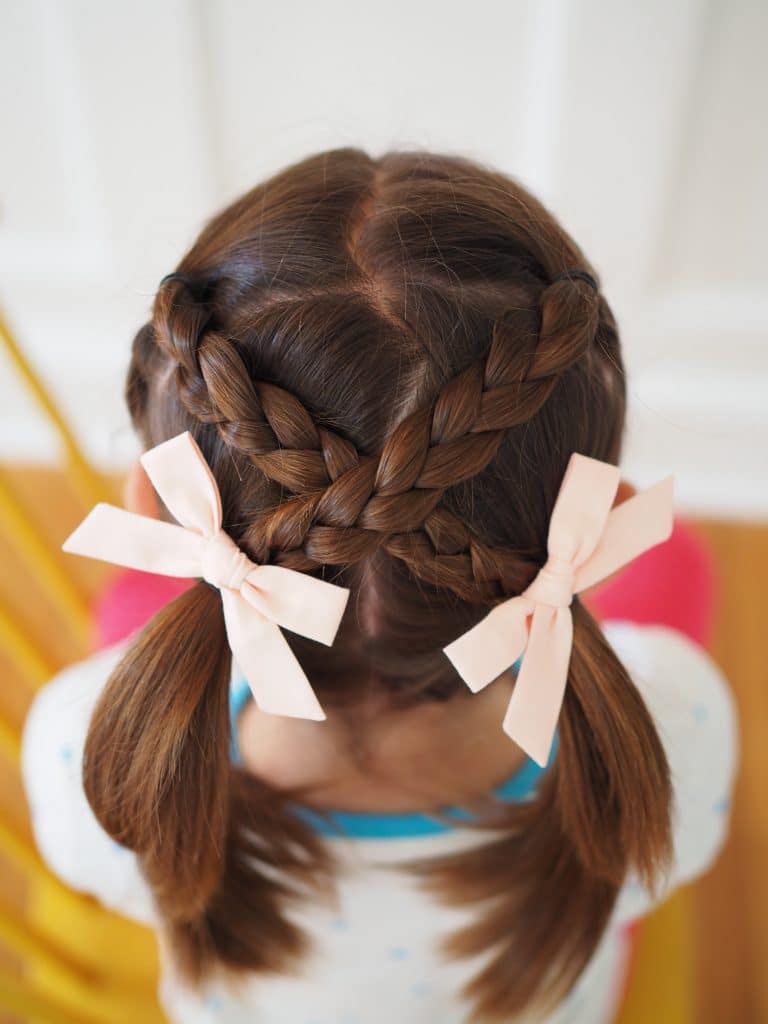
Start with a middle parting on clean, straight, medium-density hair at shoulder length. Section the crown into a five-point star using small elastics, then braid each point toward the center. Secure the center, then continue braiding each section into a pigtail. Ask your stylist for: star braid pattern into pigtails with bows. Add a pale pink bow at the base of each pigtail to hide the elastics. The trick is keeping the star centered, so use a mirror above the head, not just one in front.
Thick Twists With Geometric Parting
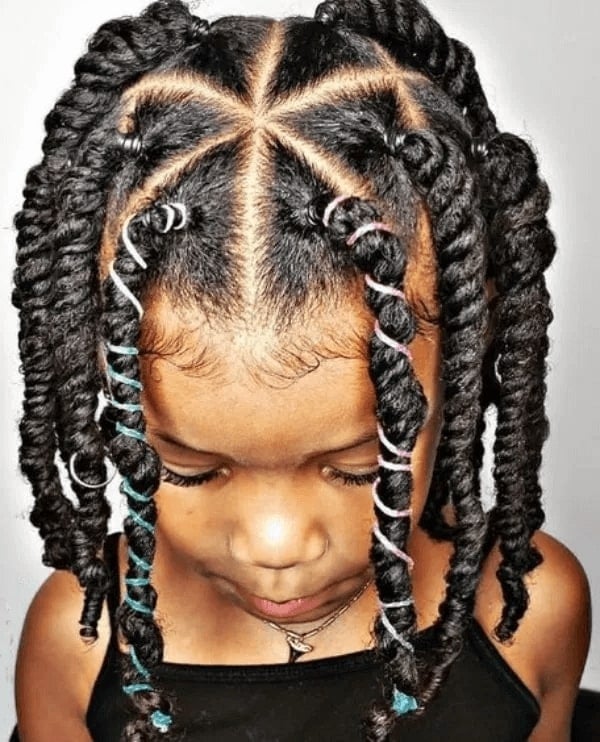
Large two-strand twists with a geometric parting on top give thick, coily hair a clean structure that holds all day. This style genuinely flatters shoulder-length hair with enough density to keep the twists from looking thin, and the colorful elastics at each section make the geometric pattern pop. Ask your stylist for: two-strand twists with geometric parting. A salon visit is not necessary here; a wide-tooth comb and a moisturizing balm let you recreate the parting and twists at home in about twenty minutes. The parting will stay crisp for two or three days before it starts to soften, which is usually when you want to redo it anyway.
Naturally Curly Shoulder Length Hair
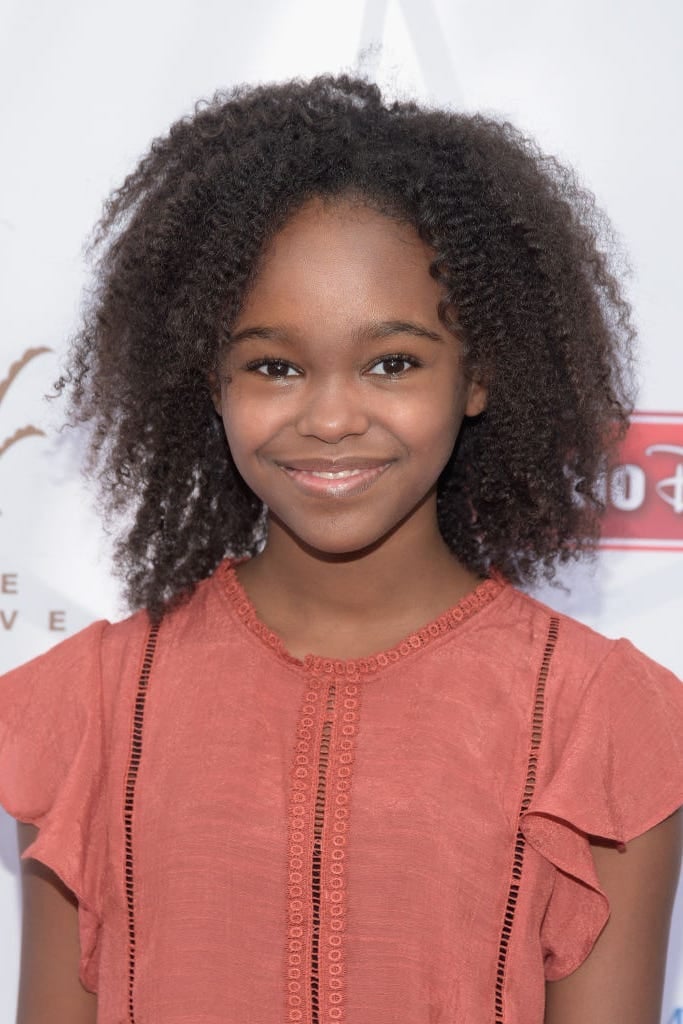
Loose, air-dried curls at shoulder length with a middle part are the fastest option in this collection, but the reality of thick, curly hair is that frizz shows up by midday if you skip the prep. This texture is naturally high-volume, so a few layers cut through the density keep the shape balanced. Ask your stylist for: loose, air-dried curls. Apply a curl cream on wet hair, then scrunch with a microfiber towel and do not touch it until it is fully dry. The drawback is that second-day curls need a water spritz and a little more product to bounce back, which adds five minutes to the morning routine.
Braids to High Bun With Beads and Rings
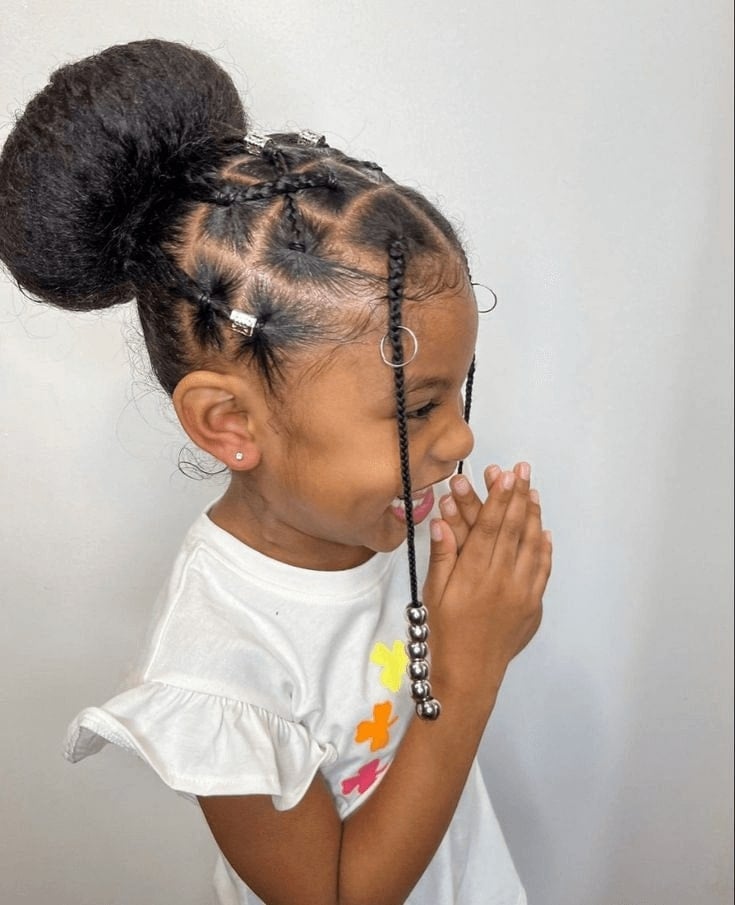
How do you get beads and rings to stay put without sliding down the shaft? The trick is the braid. Here, thick coily hair is sectioned into geometric patterns at the scalp, then braided with silver beads and rings woven in at intervals. All those braids feed into one large, high bun on top of the head. A single thick braid with oversized beads hangs loose on one side for balance. This is a salon-level style for mid-back length or longer, and the beads need to be clamped on properly so they hold through a school day or a party. Ask your stylist for: braids with beads and rings into a high bun. The bun itself should be pinned tightly enough that it does not pull on the scalp.
Wavy Ponytail With Large Bow
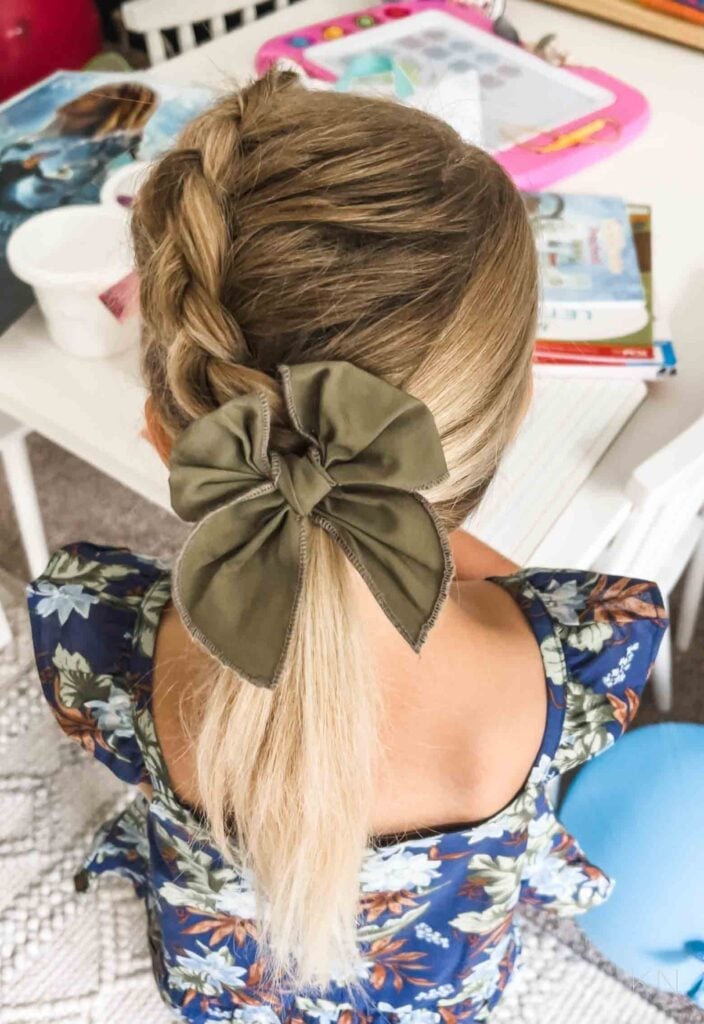
The design here is simpler than it looks: one loose braid that runs from the crown straight into a low ponytail. That braid breaks up the texture so the wavy blonde hair looks polished, not messy. A large olive green bow sits at the base of the ponytail and draws the eye. To get close at home, start with a middle part, then French braid the top section from the hairline to the nape. Gather the braid with the rest of the hair into a low ponytail. Backcomb the ponytail slightly before wrapping the elastic. Ask your stylist for: braided low ponytail with a large bow. Clip the bow on last so it sits flat against the elastic.
Bubble Ponytail With Smooth Texture
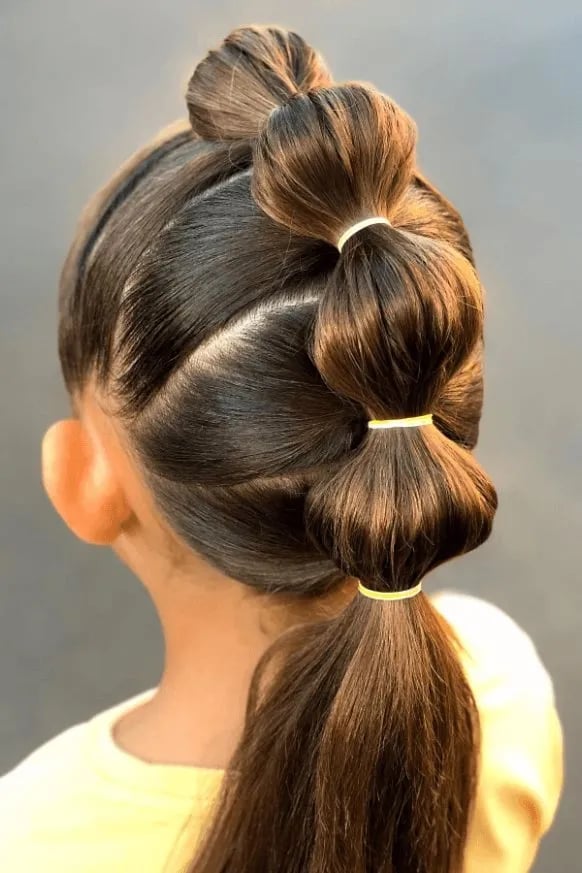
A regular ponytail can look flat by lunch. This version adds structure with elastic bands placed every few inches down the length, creating bubbles. The dark brown hair here is thick and straight, so the bubbles hold their shape without extra product. A middle part keeps the scalp neat. The difference between a DIY bubble ponytail and a salon one is the spacing. At home, eyeball two-inch intervals and use clear elastics. A stylist will measure each section and pull the bubbles evenly so none deflates faster than the others. Ask your stylist for: bubble ponytail. Start with damp hair and a smoothing serum to keep the surface glassy.
Shoulder Length Space Buns
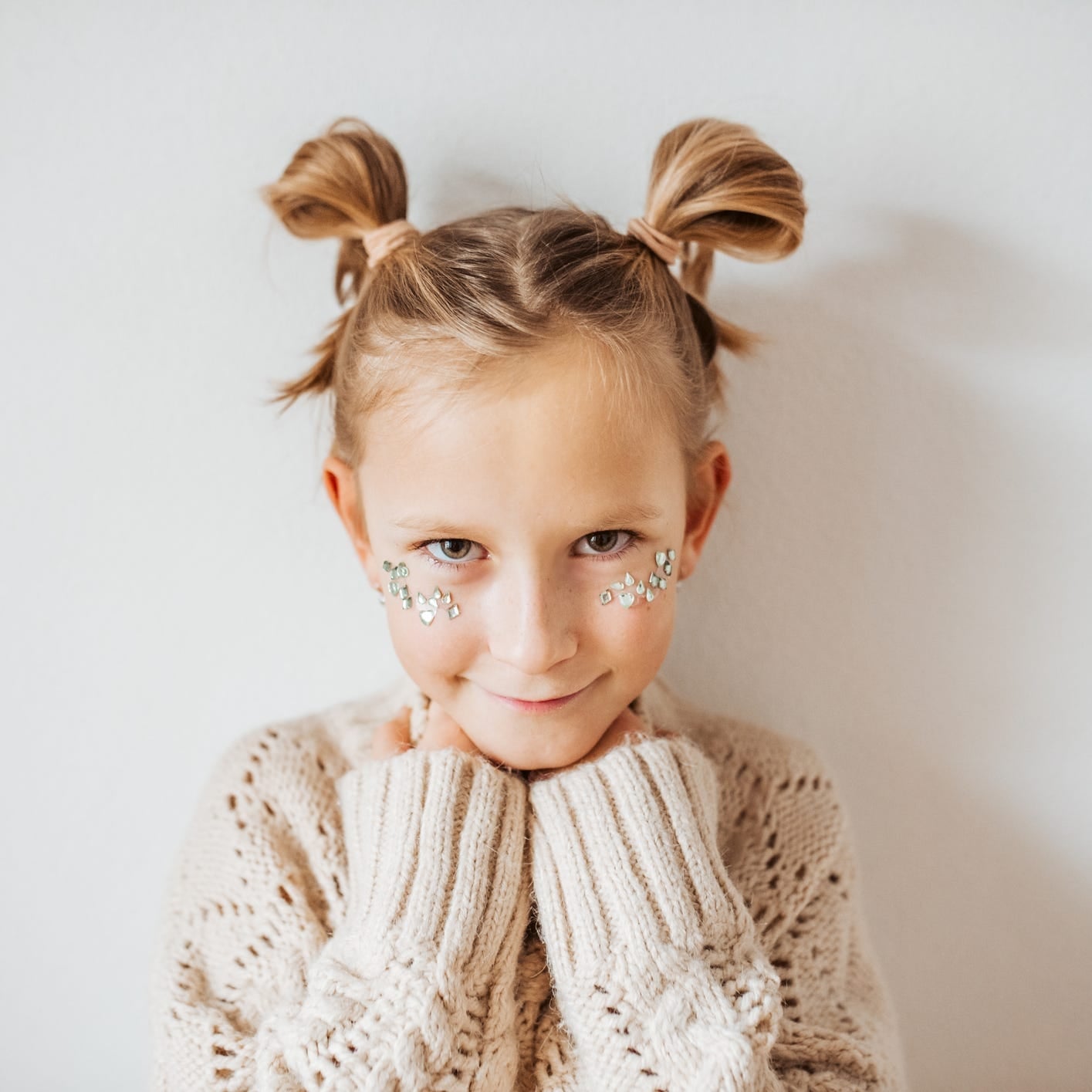
Can you pull off space buns when your hair only hits the shoulders? Yes, and this photo proves it. The key is keeping the buns compact so they sit on top of the head instead of flopping to the sides. Straight blonde hair with a middle part is split into two equal sections, twisted into tight coils, then wrapped into small buns secured with pins. Medium-density hair is ideal; very fine hair may need a texturizing spray for grip. The style holds through gym class and nap time because the buns are small enough not to shift. Ask your stylist for: double space buns. A little dry shampoo at the roots before you twist adds friction so the buns stay put.
Box Braids With Pink Streaks
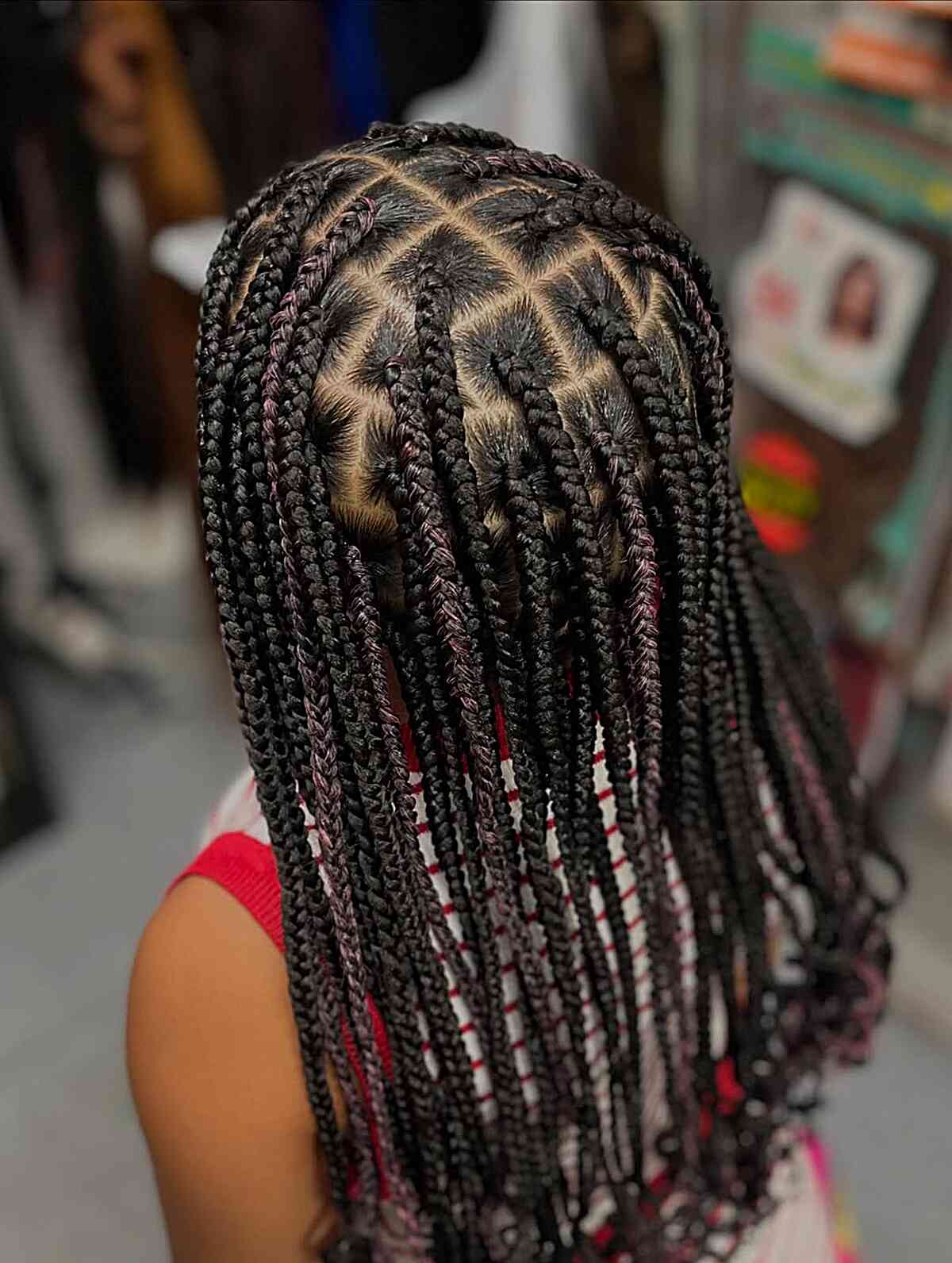
The pink streaks here are not all-over color. They are woven into selected box braids so the effect is accents, not a full commitment. Black hair is parted in a diamond pattern at the scalp, and the braids run straight down to mid-back length. A few strands of pink are added during the braiding process, which means the color lives inside the braid, not on top. This is a good option for spring or summer when a seasonal pop of color feels right but a full dye job feels like too much. Ask your stylist for: box braids with pink streaks, diamond scalp pattern. The pink will fade gradually; a color-depositing conditioner helps it last.
Single Side Braid With Purple Elastic
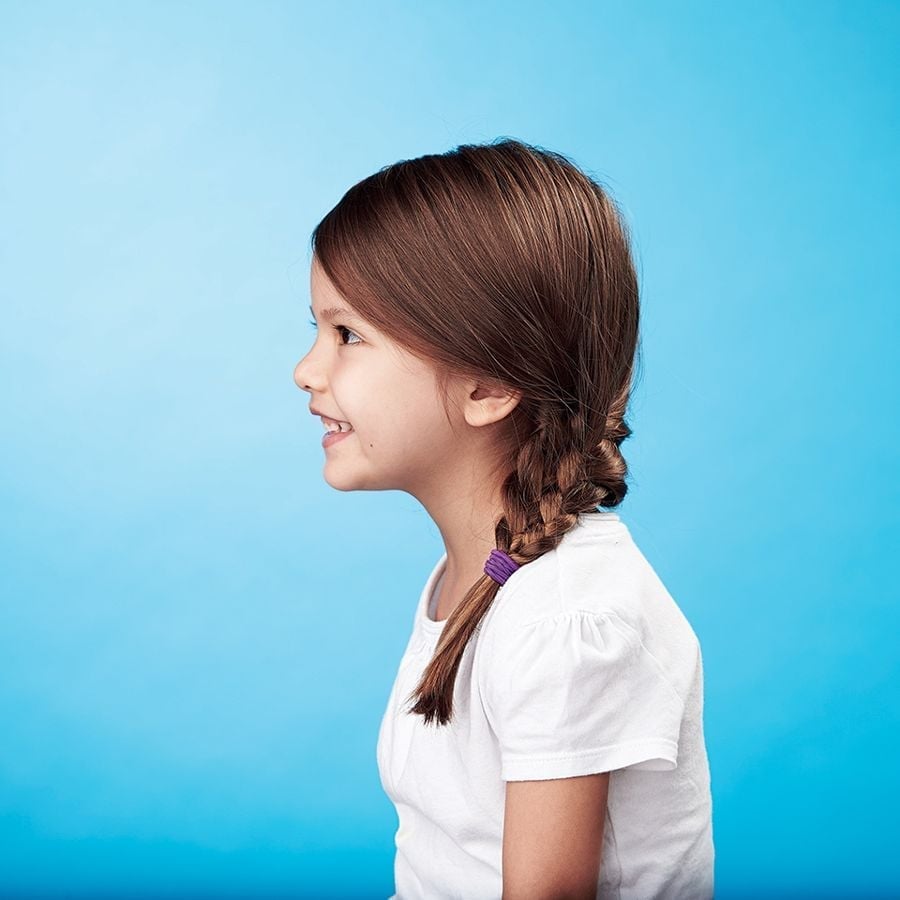
A single braid takes about five minutes and stays put all day. Brown shoulder length hair, side parted, is braided to the ends and secured with a purple elastic. Ask your stylist for: single side braid. A smoothing serum before braiding keeps flyaways in check. On very fine hair, a small clear elastic at the midpoint helps the braid stay tight through the afternoon.
High Ponytail With Ladder Braid
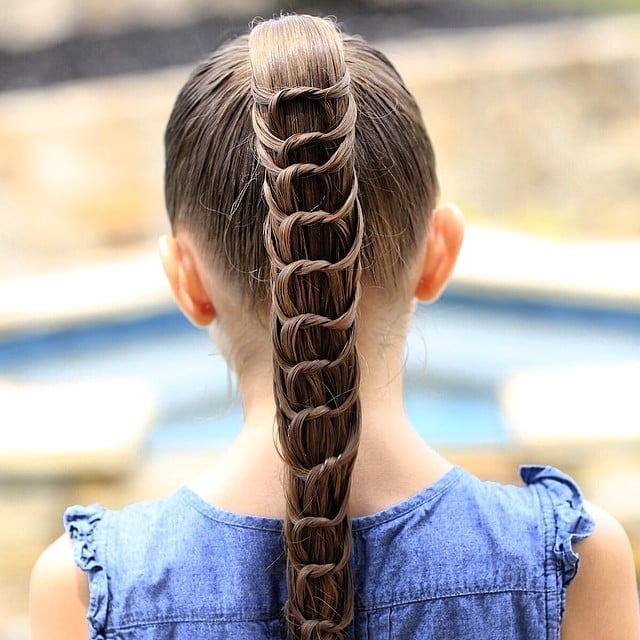
The ladder braid turns a standard high ponytail into something with actual structure. Thick, straight brown hair is pulled up to the crown, then a series of loops are created down the length of the ponytail by pulling sections through each other. Ask your stylist for: high ponytail with a ladder braid. A middle part and a tight base keep the whole thing from shifting.
This is a salon-level technique that needs a second pair of hands to get the loops even. The result holds for a full day of parties or recitals, and the loops stay defined longer than a regular braid because they are anchored at multiple points.
Braided Buns With Loose Strands
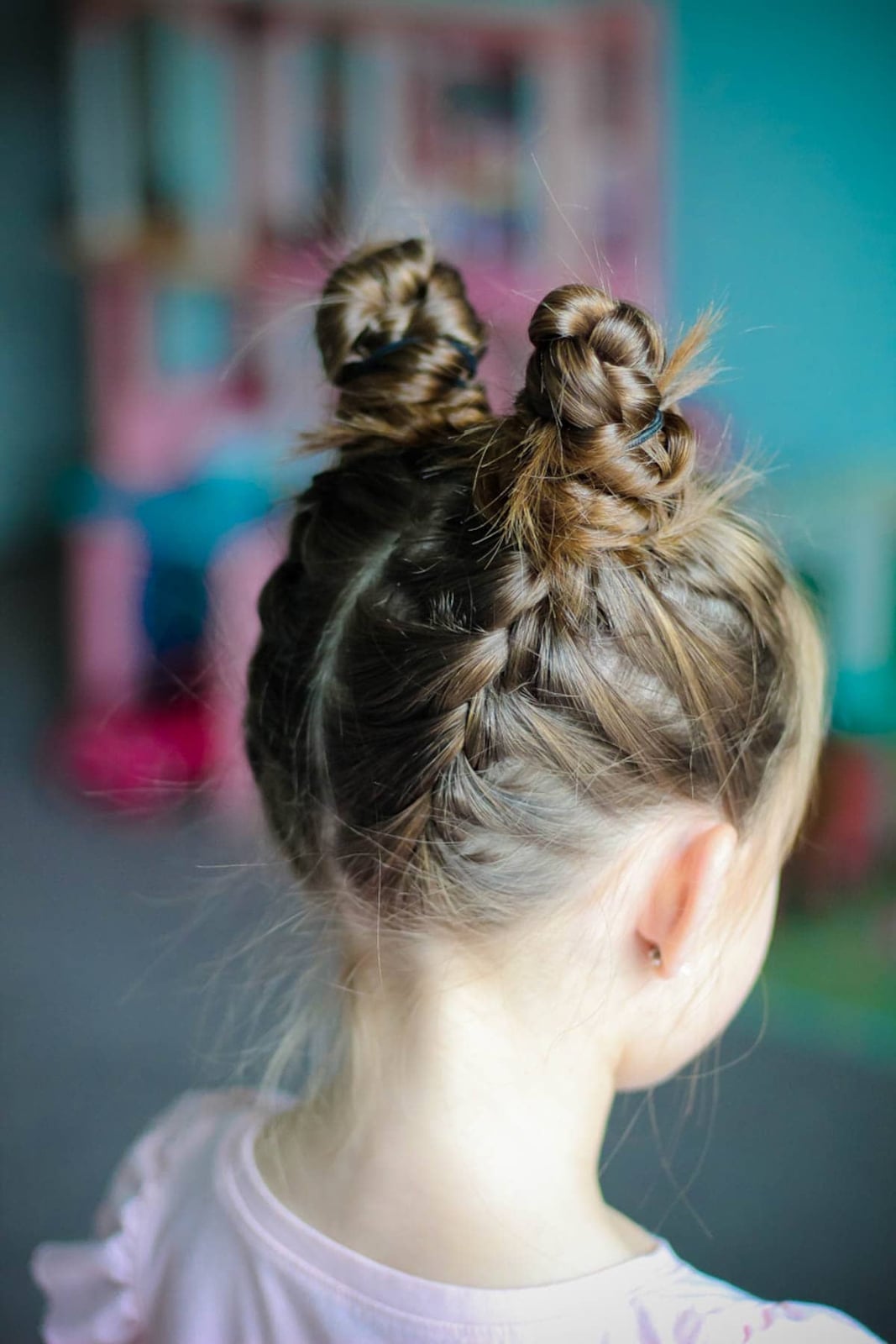
Wavy brown hair at medium length has a middle part and is braided into two separate buns on top of the head. A few strands are left loose around the edges. Ask your stylist for: two braided buns with a slightly undone look. This is a salon-leaning style, but you can get close at home by braiding each side and wrapping the braid into a bun, then gently tugging out a few face-framing pieces. The loose strands soften the whole thing without looking accidental.
French Braid Ponytail With Bandana
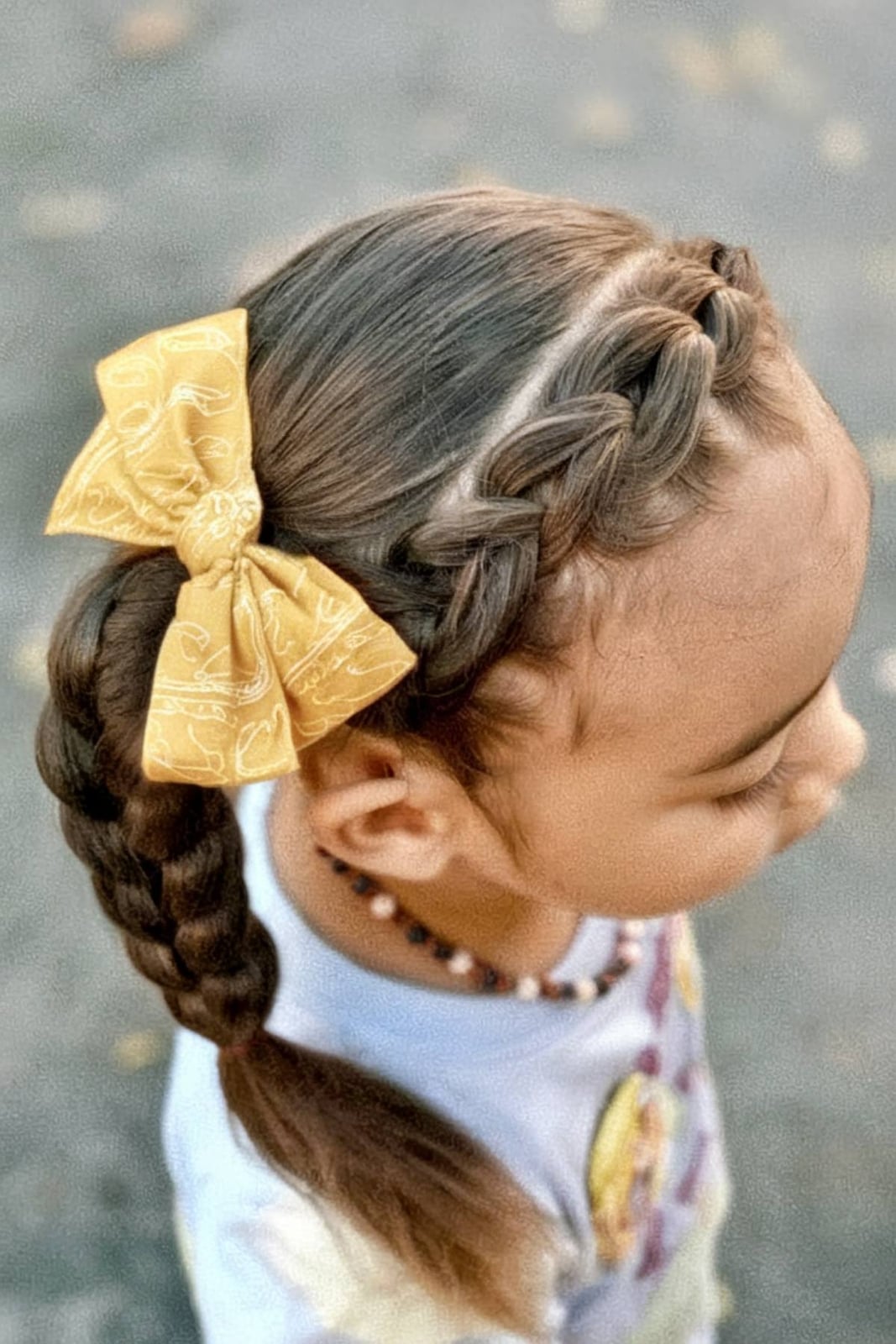
A French braid that transitions into a thick ponytail keeps hair off the face while the bandana adds a bold pop of color. Dark brown hair with subtle highlights, parted on one side, is braided from the temple back, then the rest falls into a ponytail. A large yellow bandana bow sits at the crown. Ask your stylist for: French braid into a ponytail with a yellow bandana bow. To add the bandana at home, fold it into a strip, tie it around the base of the ponytail, and knot it into a bow. Spraying the roots with texturizing spray gives the braid enough grip to stay put through recess.
High Buns With Braids and Black Bows
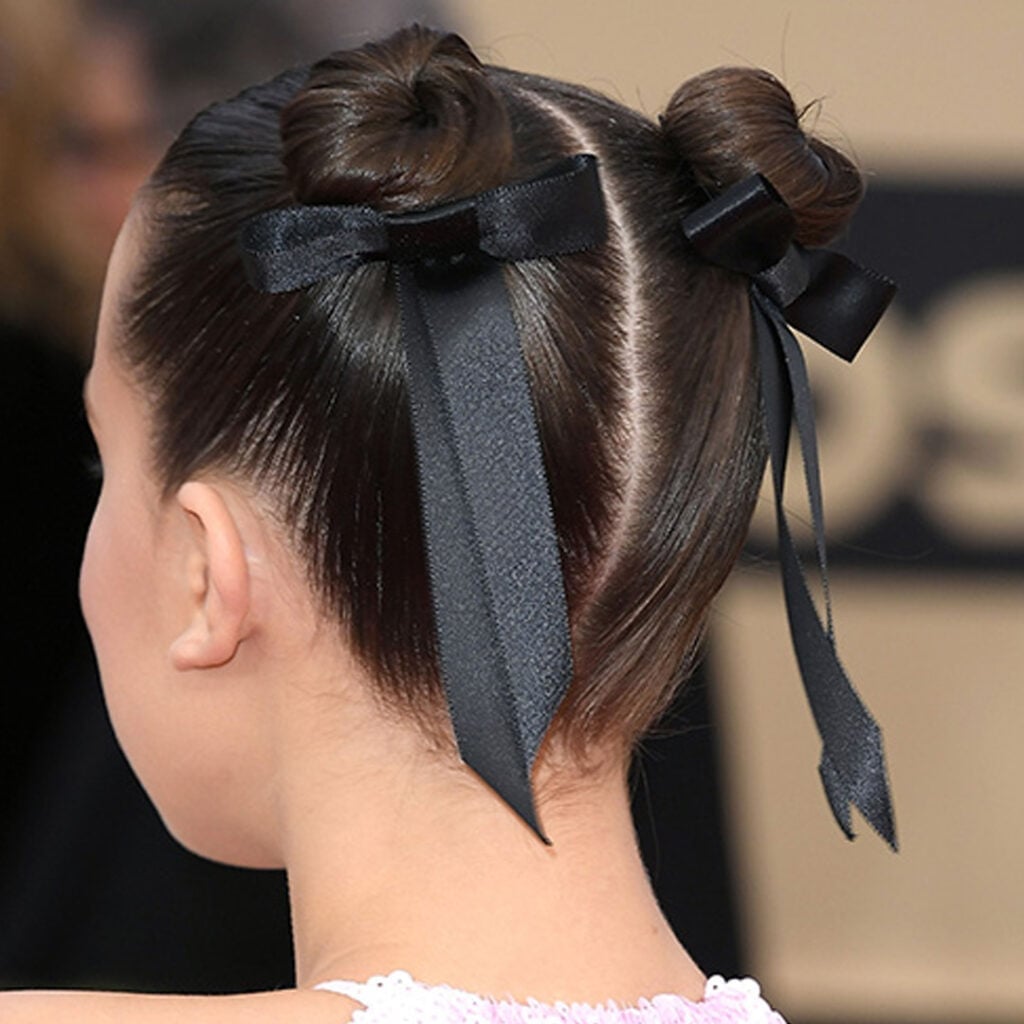
Thick, straight hair is the ideal candidate for buns that sit high and stay put. Dark brown hair at shoulder length is parted down the middle, with small braids woven into the base of each bun before wrapping the rest into a round shape. Large black satin bows are pinned at the center. Ask your stylist for: two high buns with braided bases and black bows. This is a salon-level style, mostly because getting the braids even on both sides takes practice. The bows hide the pins and give the whole thing a polished finish that lasts through a full day of events.
Stacked Bubble Ponytails
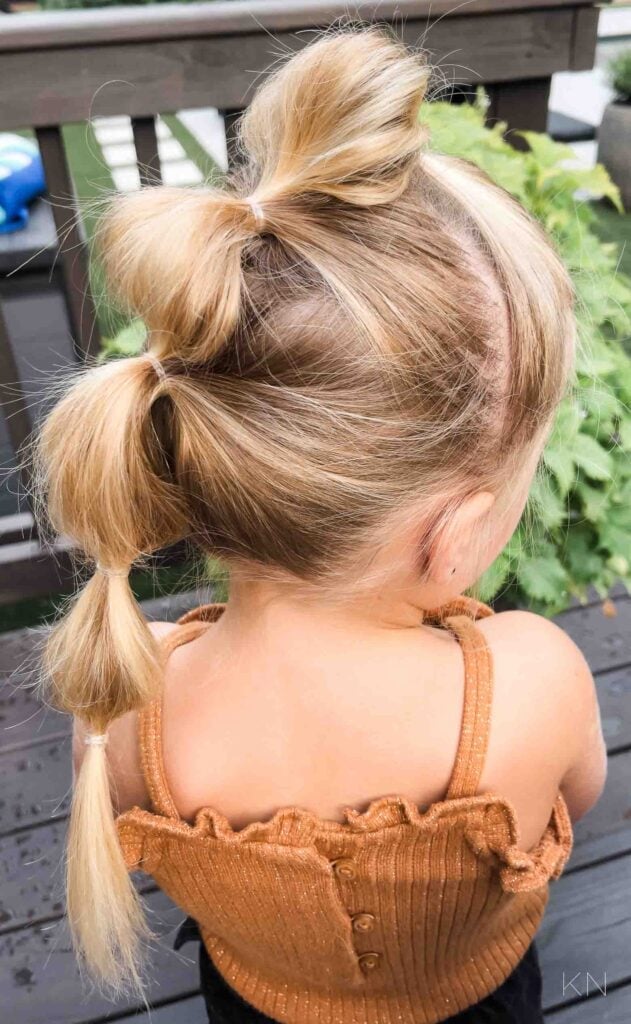
Can a ponytail hold its shape all day on fine hair? The stacked bubble version gives it a fighting chance. Shoulder-length blonde hair gets sectioned into a vertical row of ponytails, each one elastic-spaced so the hair puffs out like a string of bubbles. The middle part keeps it tidy, and the fine straight texture actually works in your favor here: lighter hair holds the bubble effect longer without drooping. Ask your stylist for: stacked bubble ponytails. Very fine hair can lose the separation between bubbles after a few hours of running and jumping. Gently tugging each section wider after securing the elastics helps the shape last through the afternoon.
Braided Pigtails With Pink Bows
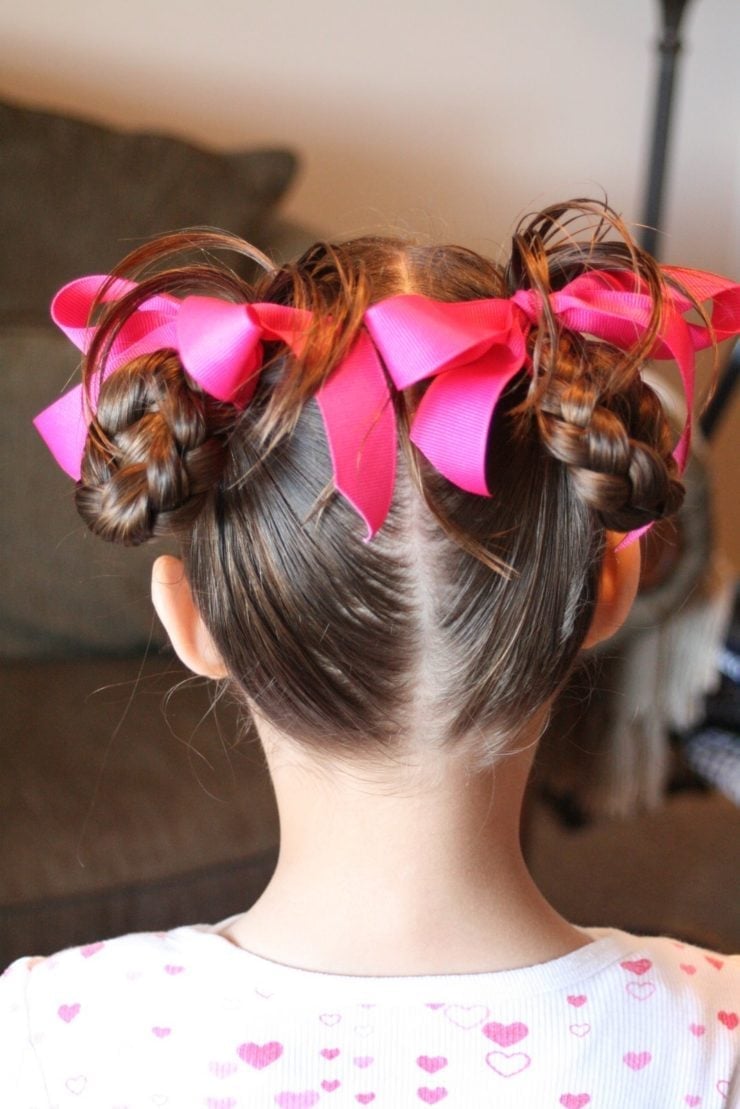
The large pink bows do not whisper. Two braided pigtails on straight mid-back brown hair get a bow anchored at the top of each braid, turning a standard school-day style into a party invitation. The bows sit where the braid starts, so they stay visible even when the hair is swinging. Ask your stylist for: braided pigtails with large pink bows. The caveat is placement: if the bows slide down the braid, the look loses its punch. Securing them with a bobby pin through the bow loop and into the braid base keeps them put.
Geometric Braided Sections With Ponytails
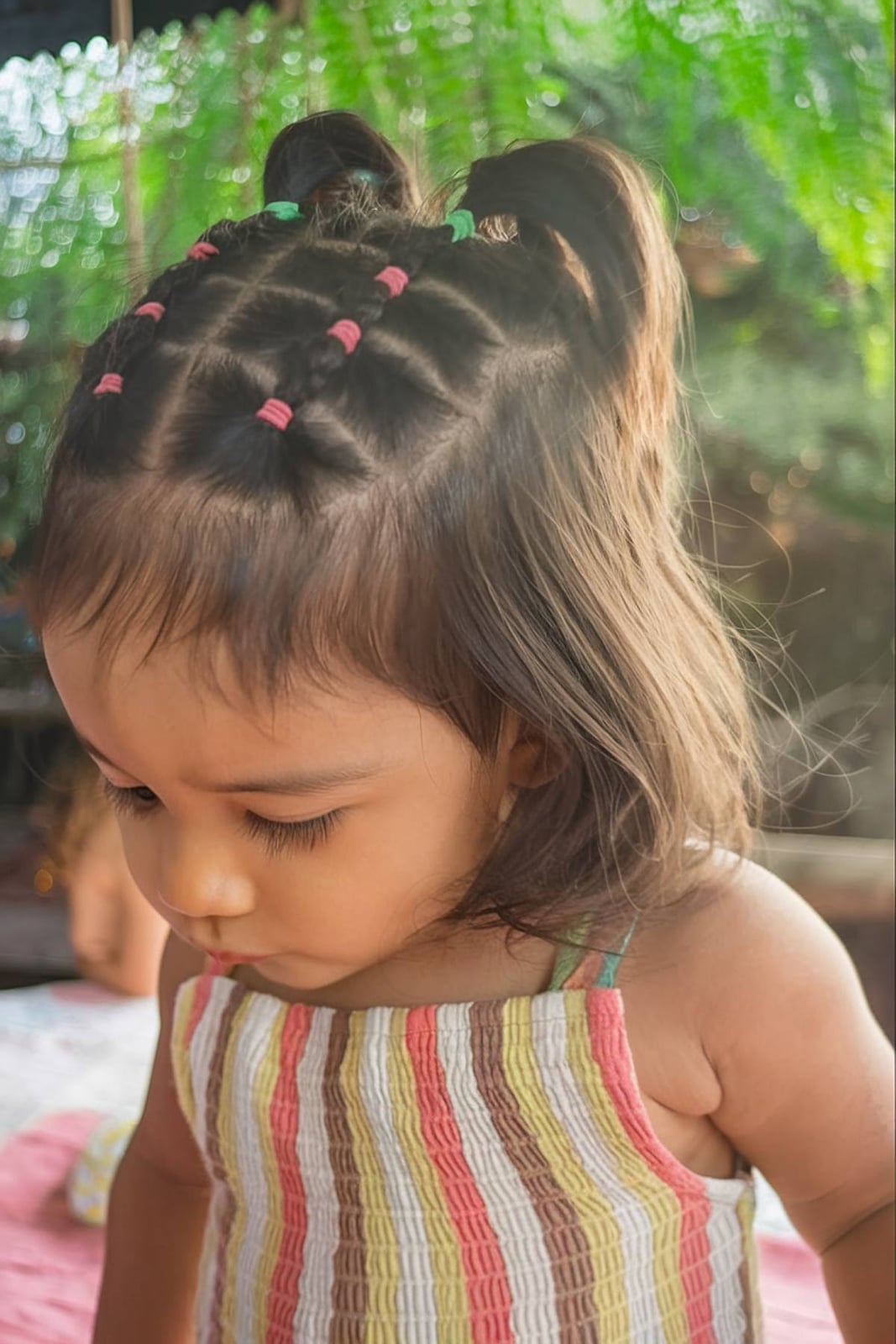
Small braids sectioned into precise shapes create a pattern that looks complex but follows a simple grid. On shoulder-length dark brown hair, the geometric sections are worked near the crown and temples, each braid sealed with a pink elastic, while the rest of the hair falls straight to two small ponytails. The fine straight texture makes the sections easier to part cleanly. Ask your stylist for: geometric braided sections with small ponytails. This is a DIY project for anyone comfortable with a rat-tail comb and small elastics: a light pomade on the part lines keeps the shapes from blurring.
Thick Wavy Pigtails With Loose Waves
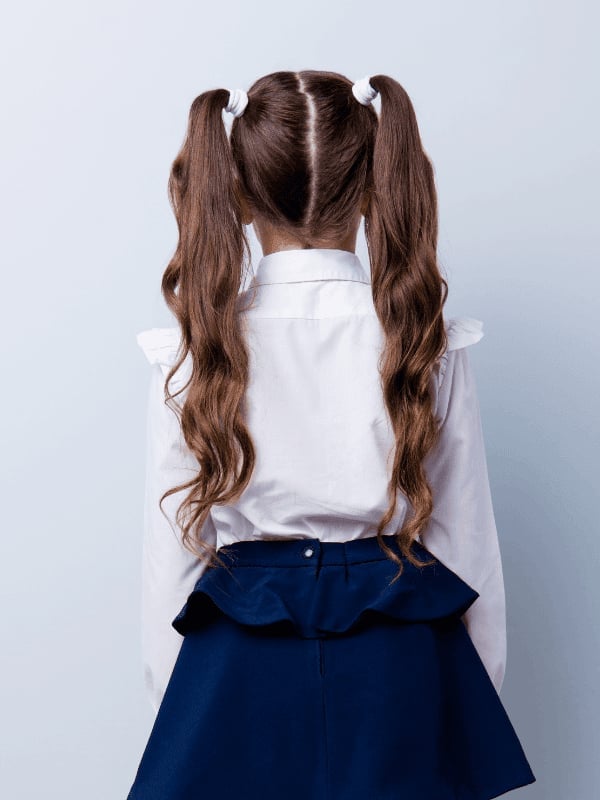
Thick wavy hair has a habit of swallowing detail in simple ponytails. Two long pigtails on mid-back dark brown hair let the natural wave pattern stretch out and move, which is exactly what this texture does best. The loose waves keep the style from looking flat, and the middle part divides the volume evenly so each pigtail swings with the same weight. Ask your stylist for: two long pigtails with loose waves. The difference between this and a basic braid is that the waves stay free, so the hair reads as fuller. A curl-defining cream brushed through before sectioning keeps the texture defined without crunch.
Double Dutch Braids to Single Braid
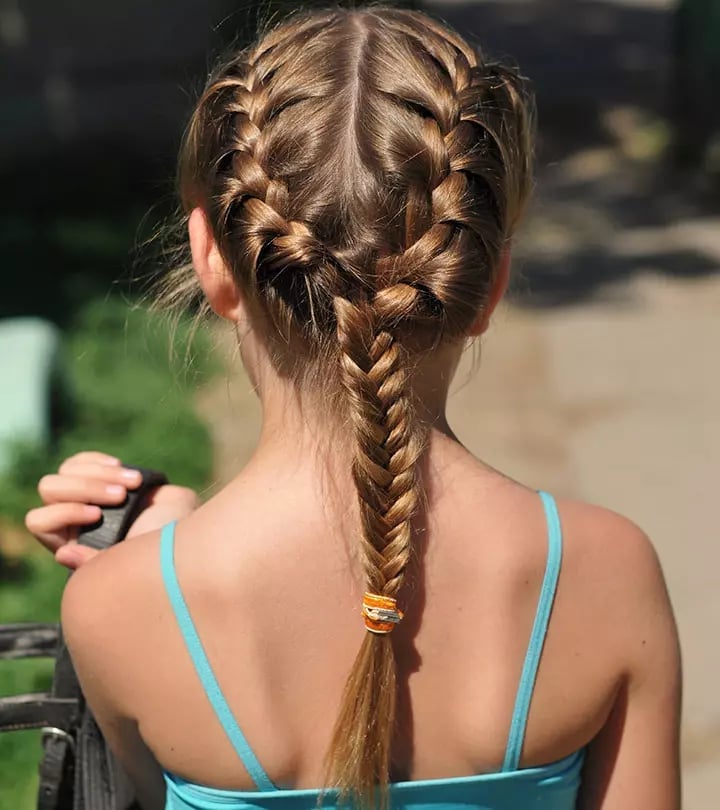
Is a single braid ever enough for thick, wavy hair? Two Dutch braids that meet at the nape and merge into one thick braid solve the problem of a braid that feels too thin. The warm blonde base shows the woven pattern clearly, and the wavy texture grips the braid sections so they do not slip loose by lunch. Ask your stylist for: double Dutch braids into a single braid. The upkeep is minimal once the braids are in: a silk scrunchie at the end prevents fraying, and a light mist of water in the morning refreshes the hold without re-braiding.
Single Side Braid With Blowout
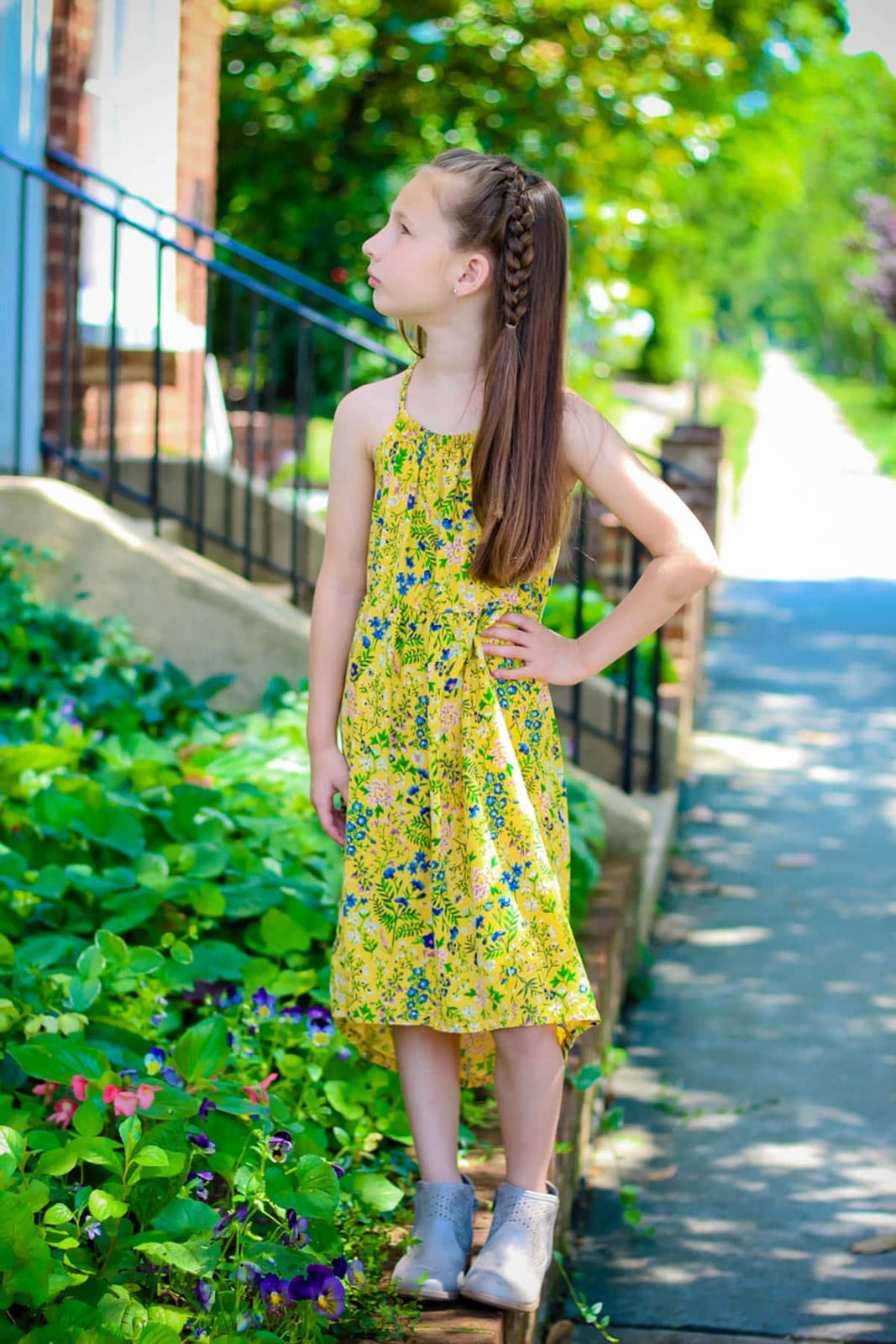
A single braid tucked along the hairline on one side lets the rest of your child’s hair stay down and flowing. This style suits thick, straight hair that reaches at least mid-back length; the braid adds detail without pulling everything up. Ask your stylist for: single side braid with hair worn down. Use a smoothing serum on the unbraided sections so the blowout stays glossy and the braid stands out as a deliberate accent rather than an afterthought.
Half-Up Braids With Diamond Pattern
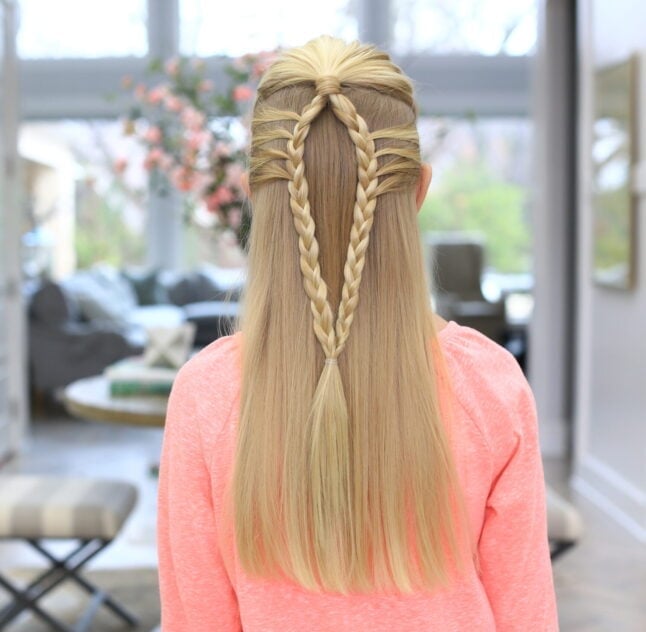
Two braids meet in the back to form a diamond shape, then the braided section is pinned up while the rest falls loose. On fine, straight blonde hair at mid-back length, the pattern is visible and precise. Ask your stylist for: half-up style with diamond braid pattern. The trade-off is that fine hair can let intricate braids slip over a long day. Use small, clear elastics at every turn and pin the ends securely to keep the diamond centered from morning to pickup.
This is not a five-minute style. Expect to spend fifteen to twenty minutes sectioning and braiding carefully, and have a small spray bottle on hand to smooth flyaways as you work.
Strawberry Blonde Waves With Curtain Bangs
Is there a way to give fine, wavy hair some movement without a full set of hot tools? Curtain bangs and loose, face-framing layers do most of the work. This style keeps the length at mid-back and uses a middle part so the bangs sweep to each side naturally. Ask your stylist for: loose waves with curtain bangs and face-framing layers. The strawberry blonde shade warms up the overall look, but the real win is how the layers create volume at the crown without teasing or product buildup.
Curtain bangs need a trim every four to six weeks to stay at the right length. If you cannot commit to that rhythm, skip the bangs and just ask for the face-framing layers instead.
Final Thoughts
For fine or thinning hair, reach for styles that build visible volume: bubble ponytails or several small braids spread across the head. For thick, coily hair, protective styles like box braids or cornrows save time in the long run and keep the hair manageable between washes.
- Trim ends every 8 to 12 weeks for blunt cuts, or as needed for braided styles.
- Deep condition coily hair weekly and use a leave-in to maintain moisture.
- Use a heat protectant when blow-drying or using styling tools; air-dry when possible.
- Wash braids gently with a diluted shampoo to avoid buildup.
- Brush fine hair from ends to roots to prevent breakage.
Simple styles are often the most effective for kids.