
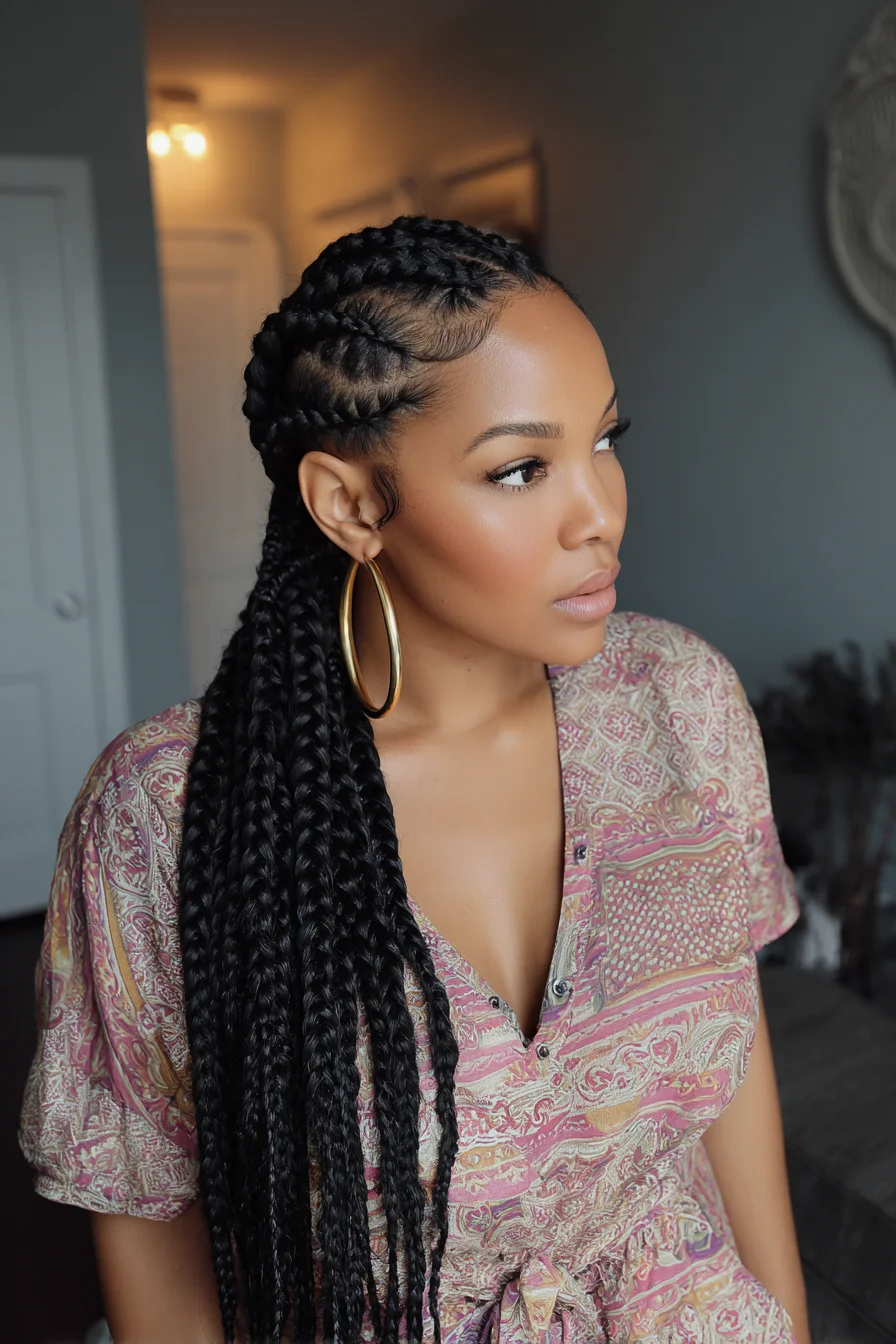
Hi, I’m Lena — a professional hairstylist with over a decade in the salon chair. In this post I showcase 28 medium knotless braids hairstyles with salon-tested techniques and real client looks to inspire your next appointment. Medium knotless braids are a gentle, protective option that suit many hair types and face shapes: from fine natural hair needing low-tension installs to thicker textures that benefit from lightweight, long-lasting styles. I’ll walk you through the looks you see in the 28 images — sleek middle parts, side-swept goddess braids, half-up buns, high ponytails and elegant low buns — plus practical tips on choosing braid size, extension weight, and leave-out blending. Expect styling advice on edge control, accessorizing, and quick updos, together with maintenance pointers to keep your scalp healthy and your braids fresh between salon visits.
Long Micro Box Braids with Feed‑In Cornrows and High Side Ponytail
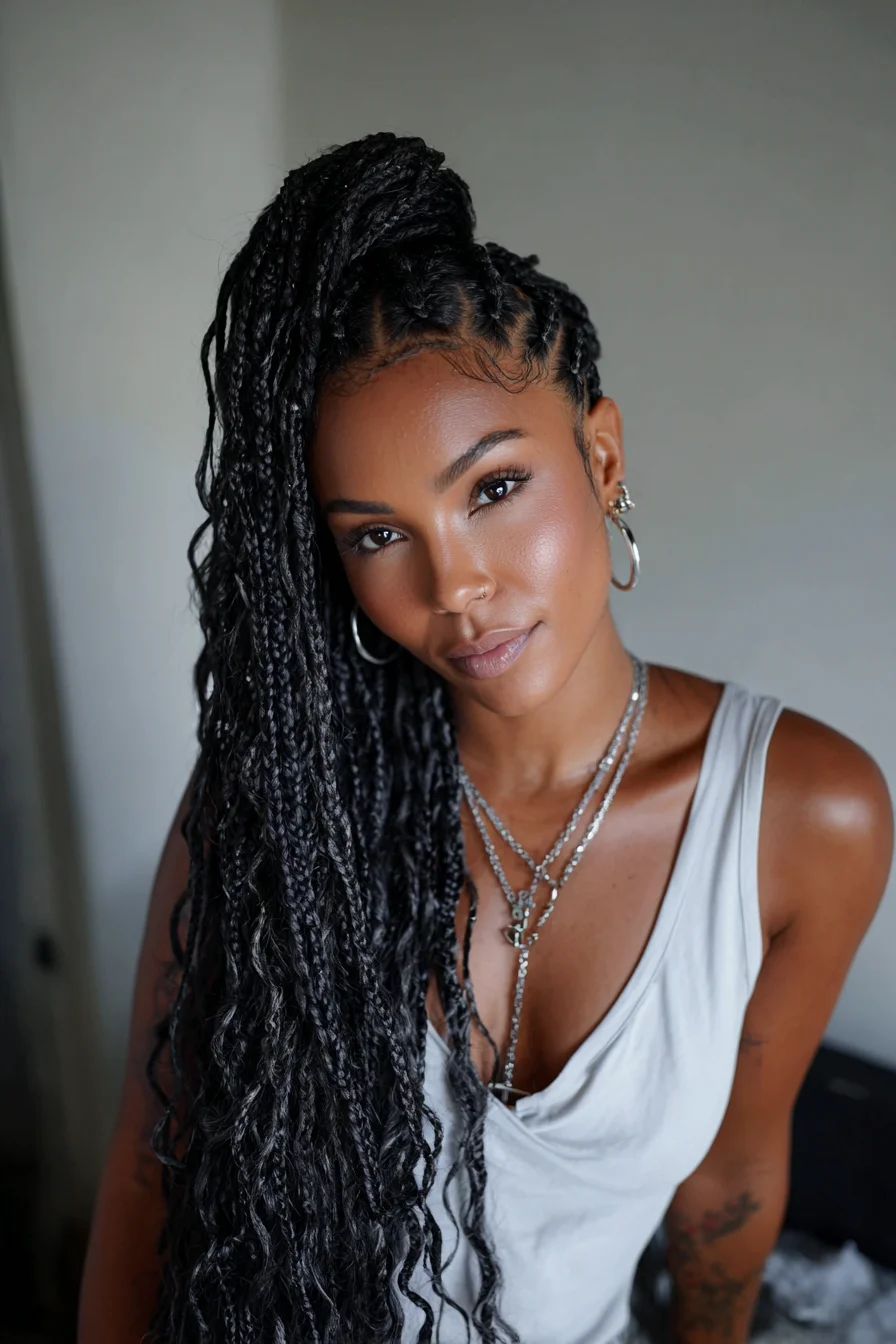
This look is a salon-ready protective style ideal for 3A–4C natural textures and clients wanting long-term low-manipulation wear. The technique combines small box braids with feed-in cornrows at the hairline, gathered into a high side ponytail for an elevated, asymmetrical finish. Prep includes clean, detangled hair and sectioning with a rat-tail comb. Add Kanekalon or premium synthetic braiding hair for length and uniform braid thickness; use the feed-in method to reduce tension at the scalp. Tools: rat-tail comb, duckbill clips, braiding hair, elastic band, edge brush, water spray bottle, scissors. Products: lightweight leave-in, anti-frizz mousse/foam, braid spray for hydration, lightweight oil or scalp serum, edge control. Difficulty: intermediate — expect 4–8 hours depending on braid size and length; a trained braider produces the neatest feed-ins. Maintenance tips: sleep on a silk scarf or bonnet, refresh edges with edge control and a soft brush, mist scalp weekly with diluted leave-in or braid spray, avoid over-tightening bands, and plan removal after 6–8 weeks to prevent shedding and breakage. Regular moisturizing and gentle cleansing extend wear and scalp health.
Long Knotless/Box Braids with Beachy Ends — Protective Braided Style
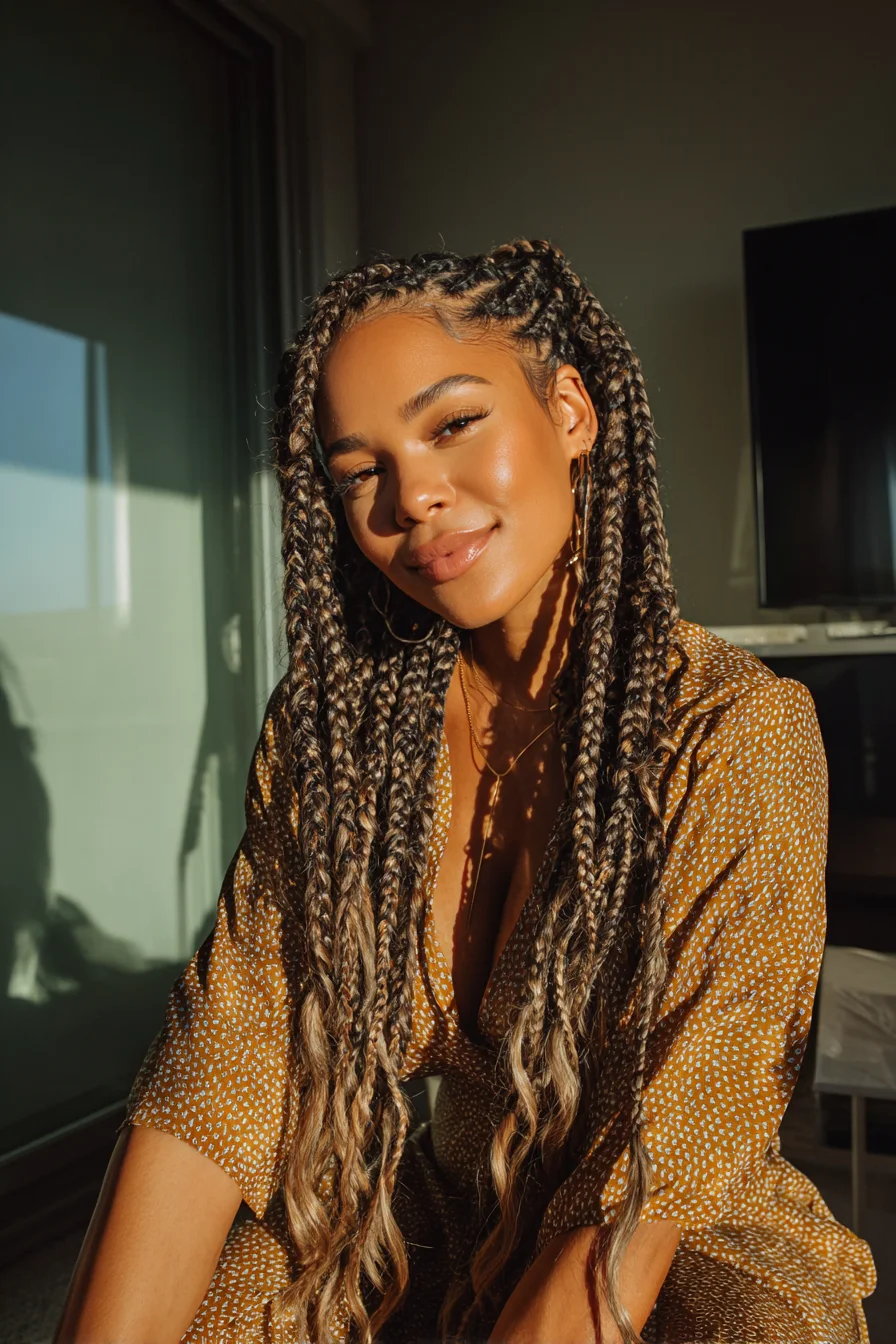
This long knotless/box-braid look with loose, beachy ends works best on medium to thick textured hair and on fine hair when using added extensions. The technique: section the hair into medium-sized panels, create small cornrows or feed-in knotless starts at the scalp, then braid down adding Kanekalon or Marley extensions for length and uniform thickness. Finish the ends by unwrapping or finger-twisting to create relaxed, wavy tips. Tools needed: rat-tail comb, sectioning clips, crochet hook (optional), silicone bands, wide-tooth comb and a blow-dryer with a diffuser (for drying after washing). Products required: cleansing shampoo (diluted), lightweight leave-in conditioner, braid mousse or setting foam, edge control, lightweight oil (jojoba or tea tree) for the scalp, and a light anti-frizz spray. Difficulty level: intermediate — expect 4–8 hours in the salon depending on density. Maintenance tips: sleep on a silk/satin scarf or pillowcase, lightly mist scalp with a water/leave-in mix and oil twice weekly, avoid heavy creams that weigh braids down, refresh edges with edge control, and cleanse gently every 2–3 weeks. Remove or redo after 6–8 weeks to prevent matting and breakage.
Side-Swept Long Honey-Blonde Box Braids — Half-Up High Pony Protective Style
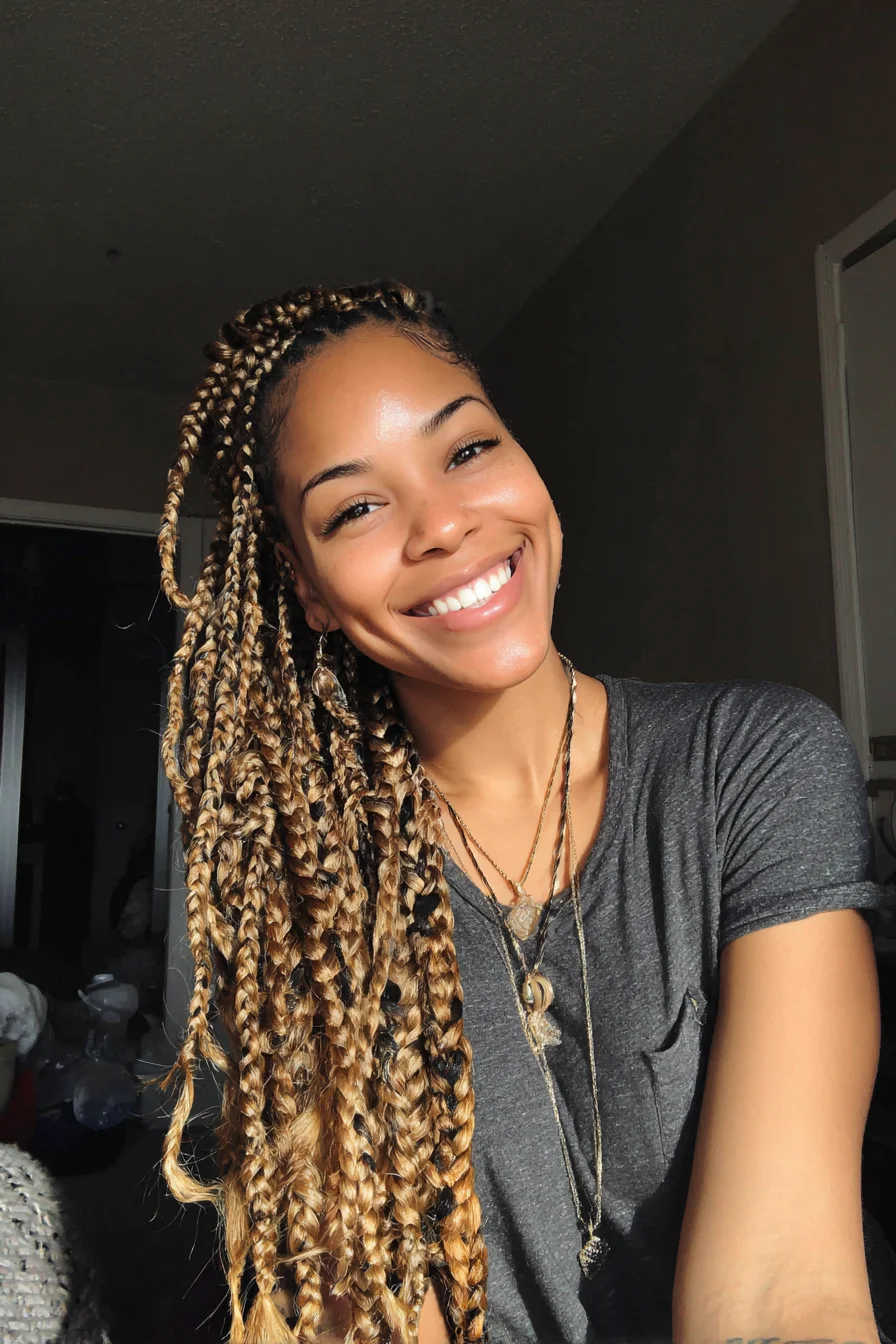
This side-swept, half-up high pony of medium-to-large box braids suits natural textured, curly, or coily hair, and can also be installed on relaxed or straight bases using extensions for length and color. Technique: create clean, squared-off partings, cornrow the perimeter to anchor, then feed-in or knot synthetic/human braiding hair to form even box braids. Gather braids to one side into a high pony and secure with a durable elastic; wrap a braid around the base to conceal the band. Tools needed: rat-tail comb, sectioning clips, braiding hair (color matched), elastics, edge brush, hair pins, and optional crochet needle for pre-loop or sew-in methods. Recommended products: lightweight leave-in conditioner, curl cream or braid moisturizer, anti-frizz mousse to set, edge control gel, and a light oil/serum for the scalp. Difficulty level: moderate to advanced — expect 4–8 hours depending on size and skill; salon installation recommended for even tension. Maintenance tips: sleep on a satin bonnet, moisturize scalp twice weekly, refresh edges with gel, cleanse gently (diluted shampoo), and remove or redo after 6–8 weeks to avoid breakage.
Knotless Feed-In Cornrows with Long Box Braids
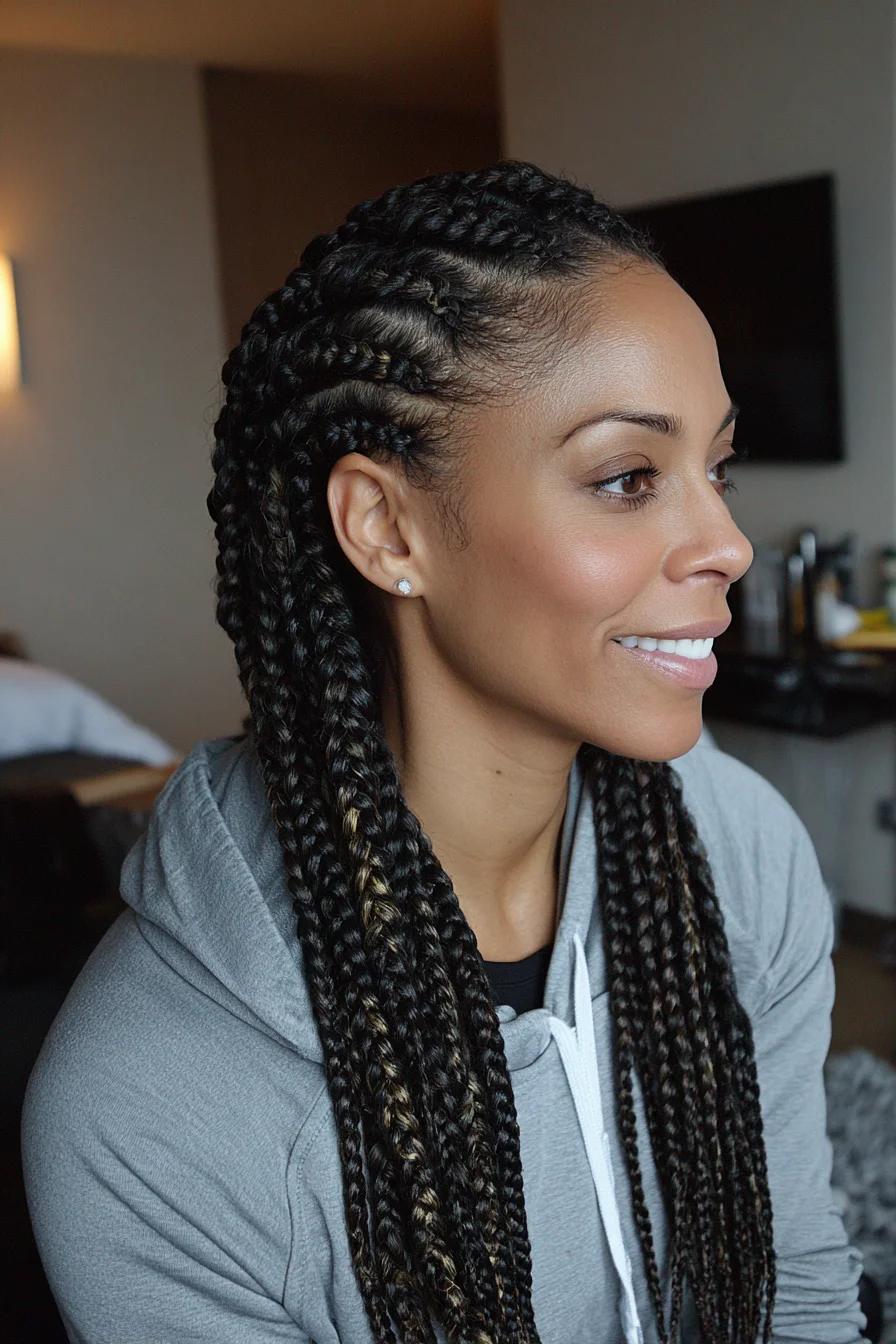
This knotless feed-in cornrow style finished into long box braids suits medium to coarse natural hair textures and can be adapted for relaxed or heat-stretched hair. Technique: section the scalp into neat rows, start each row with a small cornrow using a knotless feed-in method (adding extension hair gradually) to reduce tension and bulk, then continue the plait down the length to create individual box braids. Tools needed: rat-tail comb, sectioning clips, quality braiding hair (Kanekalon or X-Pression), small elastic bands, edge brush, and a blow-dryer or hot-water dip setup if sealing synthetic ends. Products required: leave-in conditioner and detangler, lightweight braiding gel or edge control, braiding spray or moisturizing mist, lightweight scalp oil (jojoba or tea tree), and light-hold mousse to set frizz. Difficulty level: intermediate to advanced — expect 3–6 hours depending on braid size and length; knotless technique requires practiced tension control. Maintenance tips: sleep with a silk scarf/bonnet, refresh edges gently with a small amount of edge control, mist scalp and braids weekly, cleanse with diluted shampoo and rinse thoroughly, and remove after 6–8 weeks to prevent breakage.
Long Feed‑In Box Braids with Edge Styling and Bead Accents
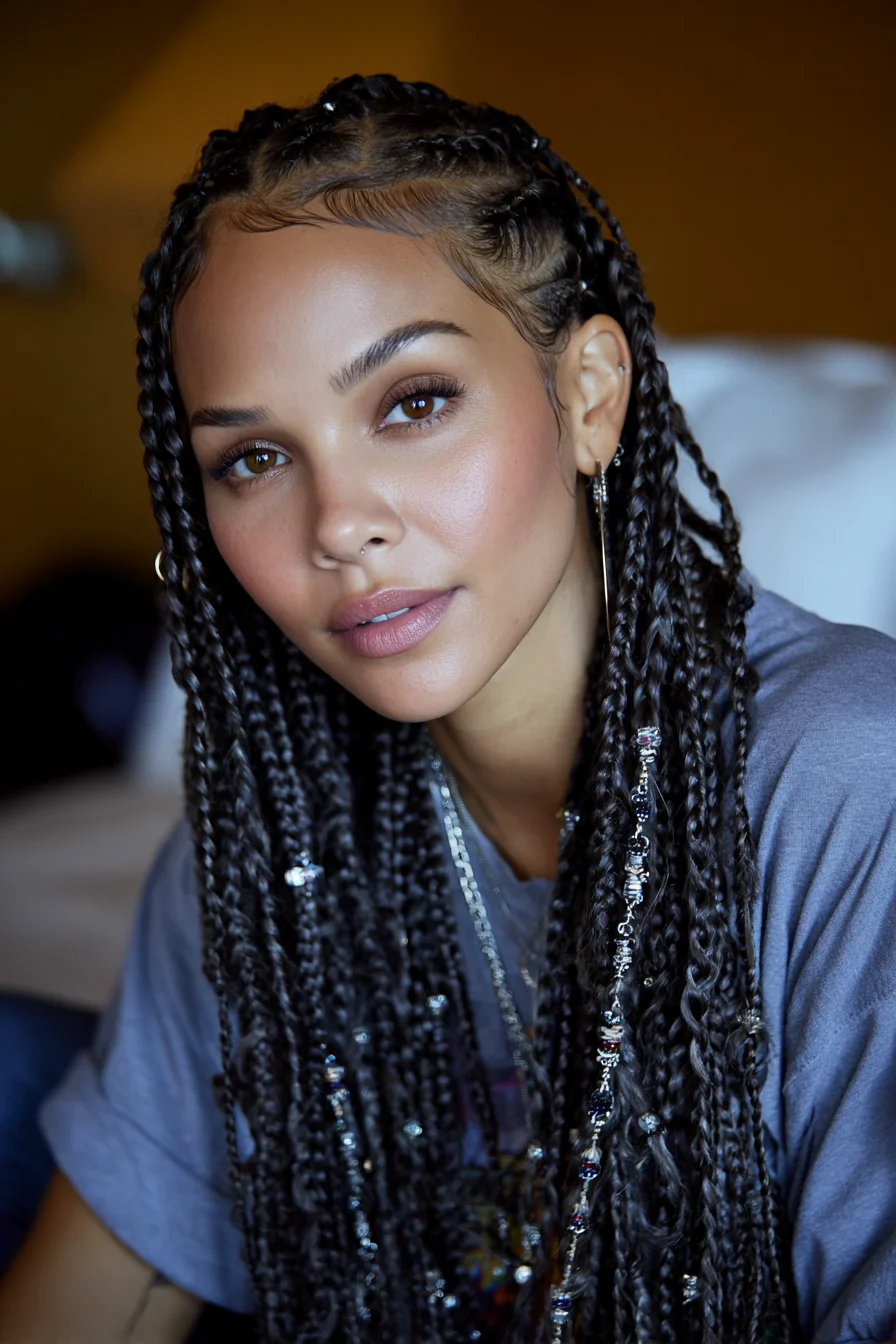
This sleek feed‑in box braid look is ideal for naturally textured hair (3A–4C) but can be achieved on straighter textures using pre‑textured braiding hair or light texturizing spray. Technique: start on clean, detangled hair; create even partings and cornrow bases using the feed‑in method (adding small amounts of Kanekalon or synthetic hair as you braid) to produce natural, lightweight roots and long, uniform braids. Finish with decorative beads, thread wraps and laid baby hairs using edge control for a polished hairline. Tools needed: rat‑tail comb, sectioning clips, fine tooth comb, edge brush/toothbrush, hair bands, blunt scissors and quality braiding hair. Products required: leave‑in conditioner, lightweight styling cream, strong‑hold edge control, braid mousse to set, braid spray for moisture, and a light oil for scalp care. Difficulty level: advanced — expect 4–8 hours depending on size; best done by an experienced braider to control tension and ensure longevity. Maintenance tips: sleep in a silk bonnet or scarf, mist braids weekly with braid spray, avoid heavy oils on the length, gently cleanse the scalp every 1–2 weeks, refresh edges as needed and remove braids after 6–8 weeks to prevent breakage.
Long Micro/Box Braids with Side-Swept Feed-In Detail
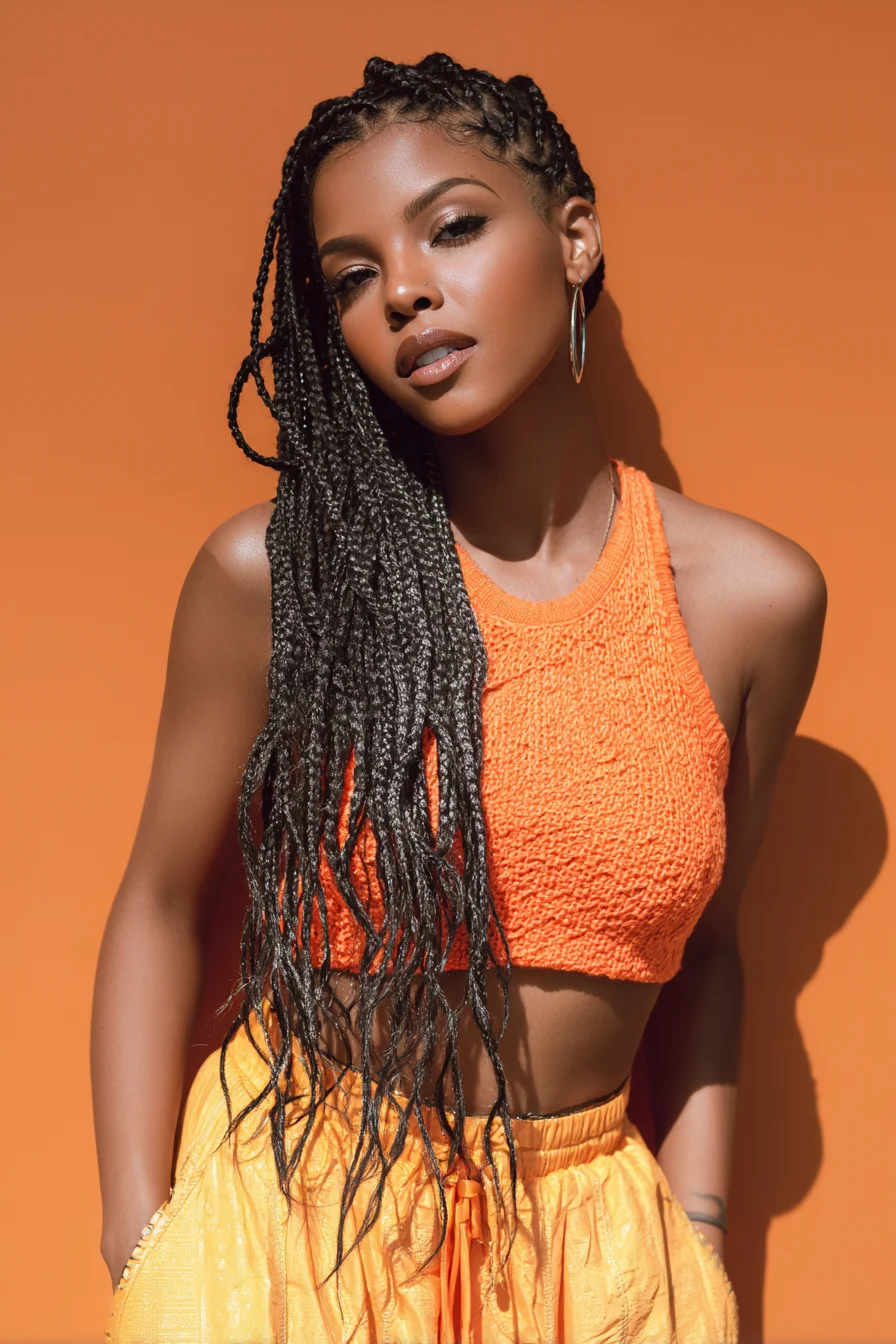
This look suits type 3 to 4 hair textures and is ideal for clients wanting long, low-manipulation protective styling. The technique uses small box or micro braids with feed-in/added extension hair at the crown, braided close to the scalp and swept to one side for a modern, asymmetrical finish. Tools: rat-tail comb, sectioning clips, braiding (Kanekalon) hair, edge brush, small elastics, scissors and a bowl of hot water if sealing synthetic ends. Products: sulfate-free clarifying shampoo before installation, lightweight leave-in conditioner, braid spray or moisturizing mist, light scalp oil (jojoba or tea tree diluted), and holding gel for baby hairs. Difficulty: intermediate to advanced — expect 4–8 hours depending on braid size and length; precision and even tension are key. Maintenance tips: sleep on a satin bonnet or pillowcase, refresh edges with a light gel and soft brush, mist braids twice weekly with a braid spray, cleanse the scalp every 10–14 days using diluted shampoo or dry shampoo, and avoid heavy oils that cause buildup. Plan touch-ups at the hairline after 4–6 weeks and remove braids by 8 weeks to protect natural hair health.
Side Cornrows into High Textured Wet‑Look Ponytail
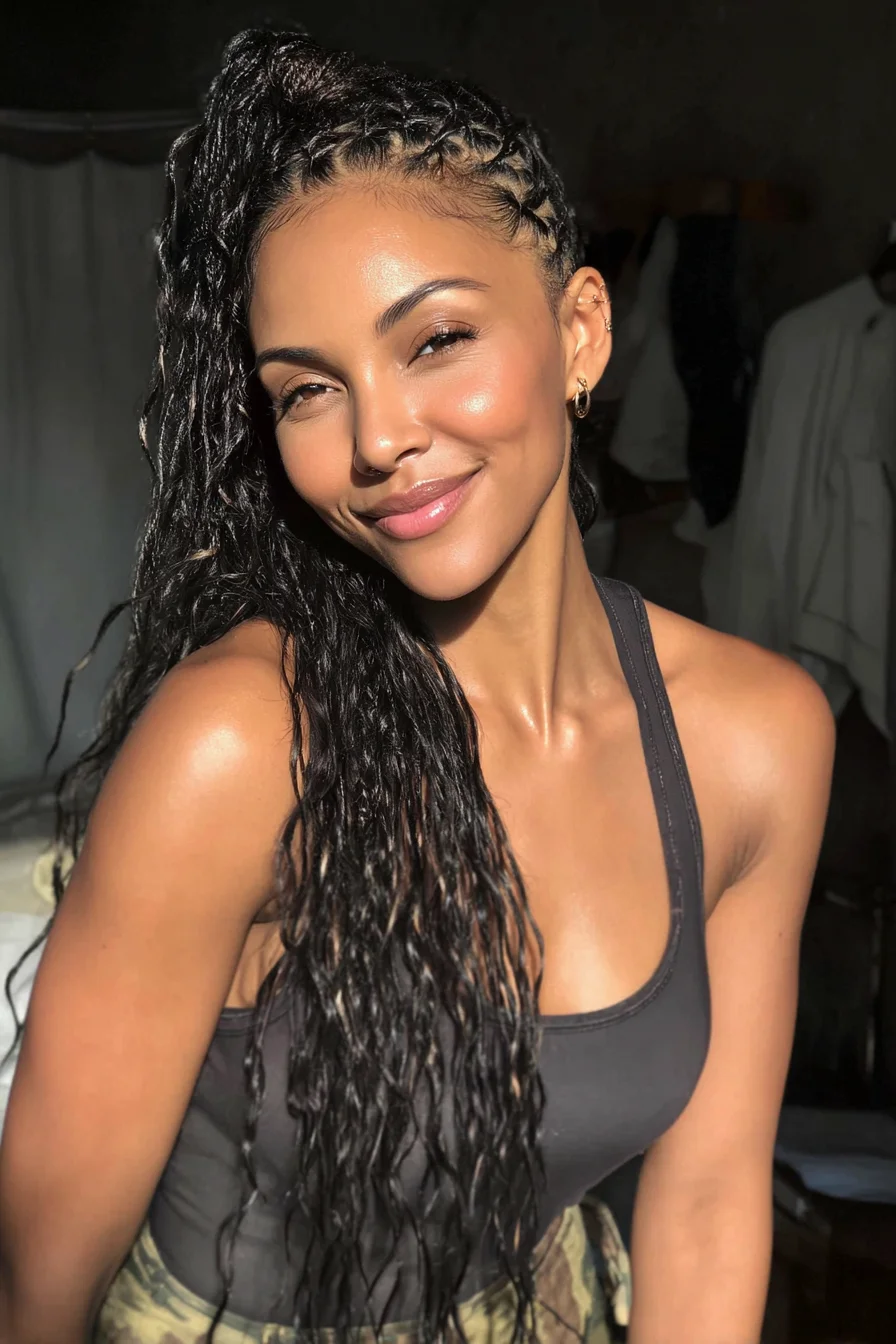
Suitability: Best for naturally wavy to coily hair (type 3–4) because it holds the cornrows and textured lengths well; straight hair can wear this style with pre-textured extensions or by creating waves with heat. Styling technique: Section and create small-to-medium cornrows along the hairline toward a high side crown, secure all braids into a high side ponytail, wrap a small strand around the elastic for a clean base, and leave or attach textured lengths for the long wet-look waves. Define or refresh waves with a diffuser on low heat or a large-barrel wand if needed, and smooth baby hairs with edge control. Tools needed: rat-tail comb, sectioning clips, small clear elastics, boar-bristle brush, edge brush/toothbrush, hair dryer with diffuser (or curling wand), and long clips for extensions. Products required: hydrating leave-in conditioner, curl cream or mousse, firm-hold styling gel for the braids, edge control, lightweight oil or serum for shine, and flexible-hold hairspray. Difficulty level: Intermediate — requires neat parting and steady braiding; allow 45–90 minutes depending on extensions. Maintenance tips: Sleep in a satin bonnet/scarf, refresh texture with water + leave-in or mousse, lightly oil the scalp weekly, avoid over-tight braiding to prevent tension, and redo cornrows every 2–3 weeks for longevity.
Knotless Long Box Braids with Cornrowed Feed-In and Blonde Accents
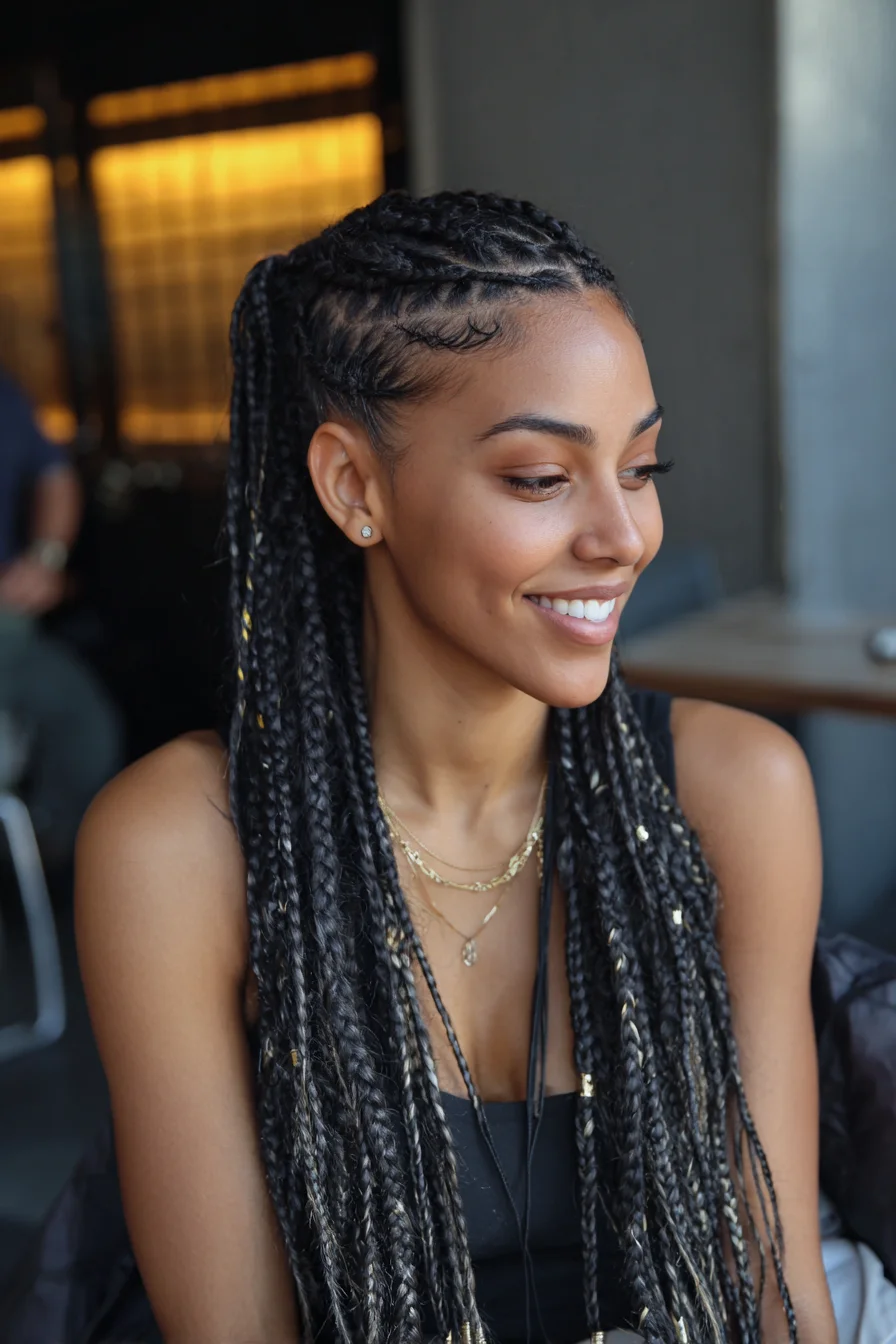
This look suits Type 3–4 natural textures and works well with added kanekalon or human hair for extra length and thickness. The technique combines neat cornrow feed‑ins along the scalp that transition into knotless/three‑strand box braids, with face‑framing baby hairs laid and a few blonde highlights or metallic hair cuffs for detail. Tools needed: rattail comb for precise parting, sectioning clips, braiding/exension hair, edge brush, small scissors, crochet needle (optional), and a mirror. Products required: leave‑in conditioner, lightweight braid spray, edge control gel, mousse to set, and scalp oil (jojoba or tea tree) for upkeep. Difficulty level: intermediate–advanced; expect 4–8 hours depending on density and length — professional installation recommended to control tension and avoid breakage. Maintenance tips: sleep on a silk/satin scarf or pillowcase, mist scalp and braids 2–3 times weekly with a hydrating braid spray, oil the scalp weekly, and gently cleanse using diluted shampoo with an applicator bottle every 1–2 weeks. Remove or redo within 6–8 weeks to protect edges and natural hair health.
Long Medium Box Braids — Classic Protective Braided Style
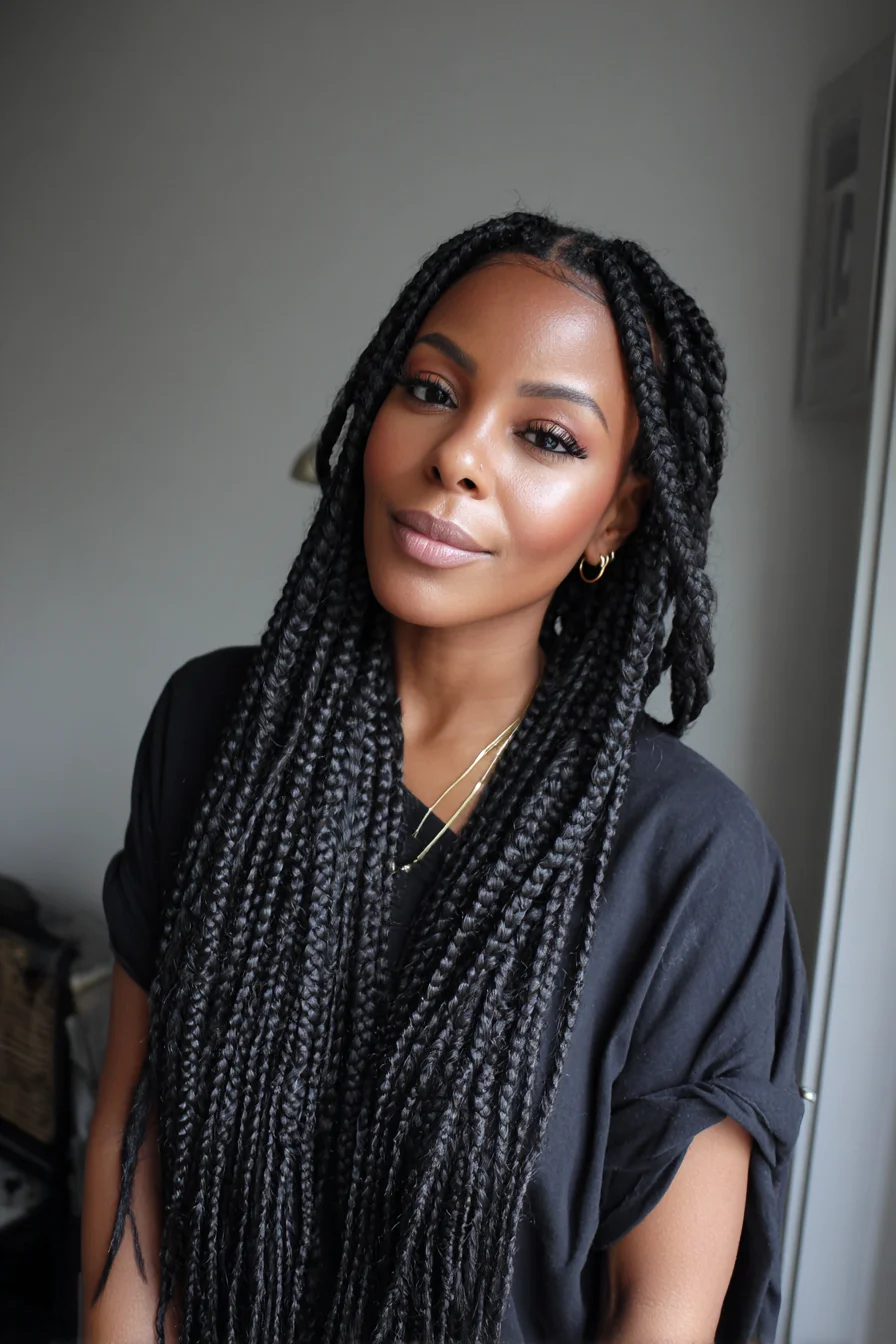
These long, medium-sized box braids are a versatile protective style suitable for natural, relaxed, or transitioning hair types. The look is achieved by cleanly sectioning the hair into square parts and installing three-strand box braids with pre-stretched synthetic hair added for length and uniform thickness. Tools: rat-tail comb for precise parting, clips, hair bands, long-tail needle or latch hook (optional), and a spray bottle. Products: lightweight leave-in conditioner, braid-setting mousse, edge control, moisturizing braid spray, and light oil or serum for scalp sheen. Difficulty: Moderate — installation is time-consuming (typically 4–8 hours) but uses basic braiding technique; professional installation is recommended to manage tension and even sizing. Maintenance tips: sleep on a silk/satin scarf or pillowcase nightly; moisturize scalp and braid lengths 2–3 times weekly with braid spray and a light oil; cleanse scalp every 2–3 weeks with diluted shampoo and careful rinsing, then air-dry completely; avoid heavy products that cause buildup; refresh edges with edge control and re-braid or tighten only the front rows as needed. Expect to wear this style comfortably for 6–8 weeks with proper care.
Side Feed‑In Cornrows with Long Wavy Extension Ponytail
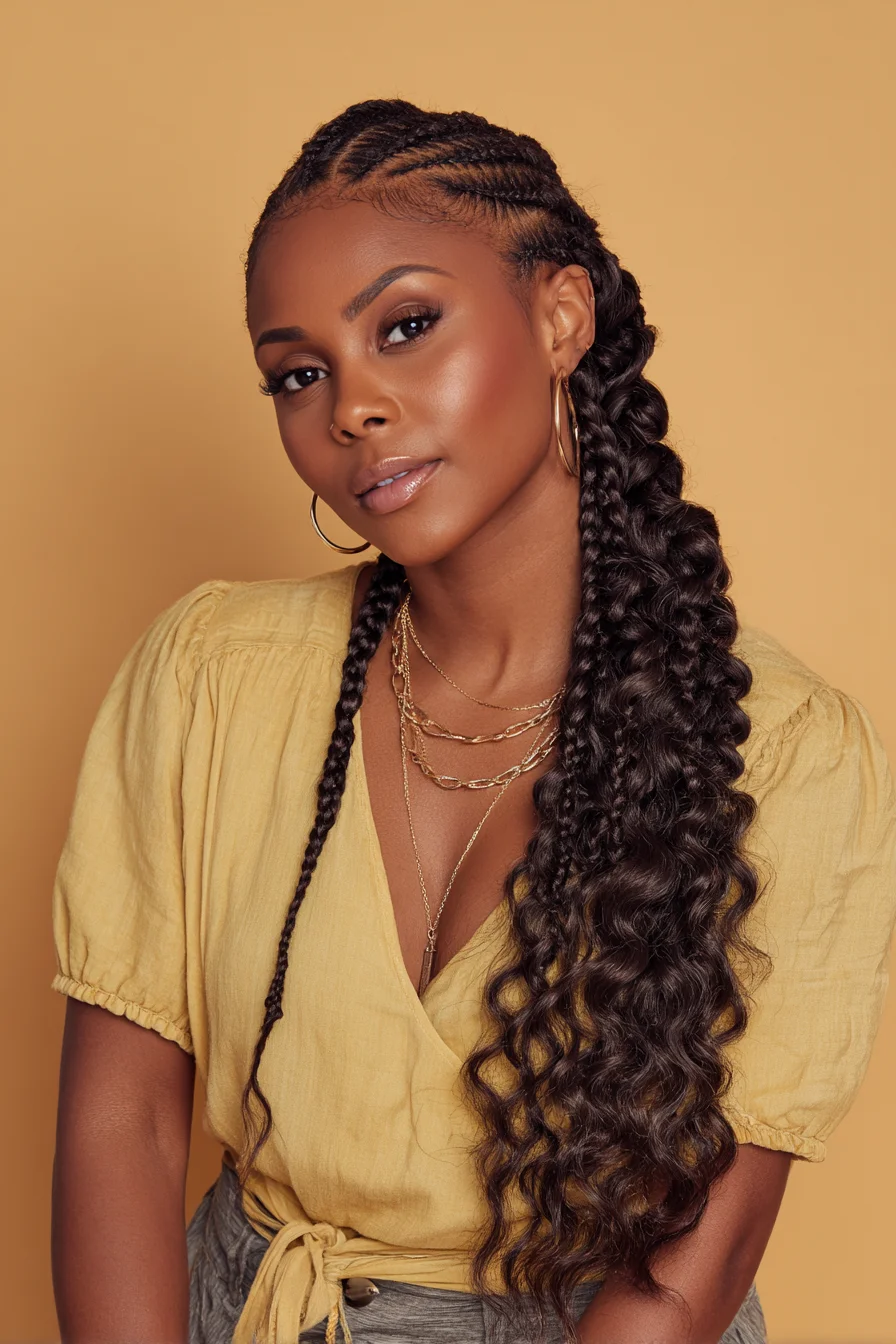
This polished protective style suits medium to coarse textured hair (3A–4C) and works best for medium to high density. Start with clean, detangled hair; create neat feed‑in cornrows along the scalp toward one side, leaving a few accent braids. Secure hair into a low/side pony and blend pre‑curled or wavy extensions with a crochet needle or by hand‑wrapping to form the long, voluminous wavy ponytail. Tools: rat‑tail comb, sectioning clips, small elastics, crochet needle (or extension loop), edge brush, blow dryer (optional) and flat iron/waver for blending. Products: lightweight leave‑in, holding gel or edge control for sleek parts, mousse for wave definition, light oil or serum for shine, and flexible hairspray for hold. Difficulty: intermediate — expect 1.5–3 hours depending on length and added hair. Maintenance tips: sleep on a satin bonnet or pillowcase, refresh edges with a small amount of edge control, lightly mist waves with water + leave‑in to revive texture, avoid heavy oils at the roots to prevent slippage, and redo cornrows after 3–4 weeks to protect the hairline. Remove extensions after 6–8 weeks and deep condition.
Sleek Feed-In Cornrows into Long Box Braids
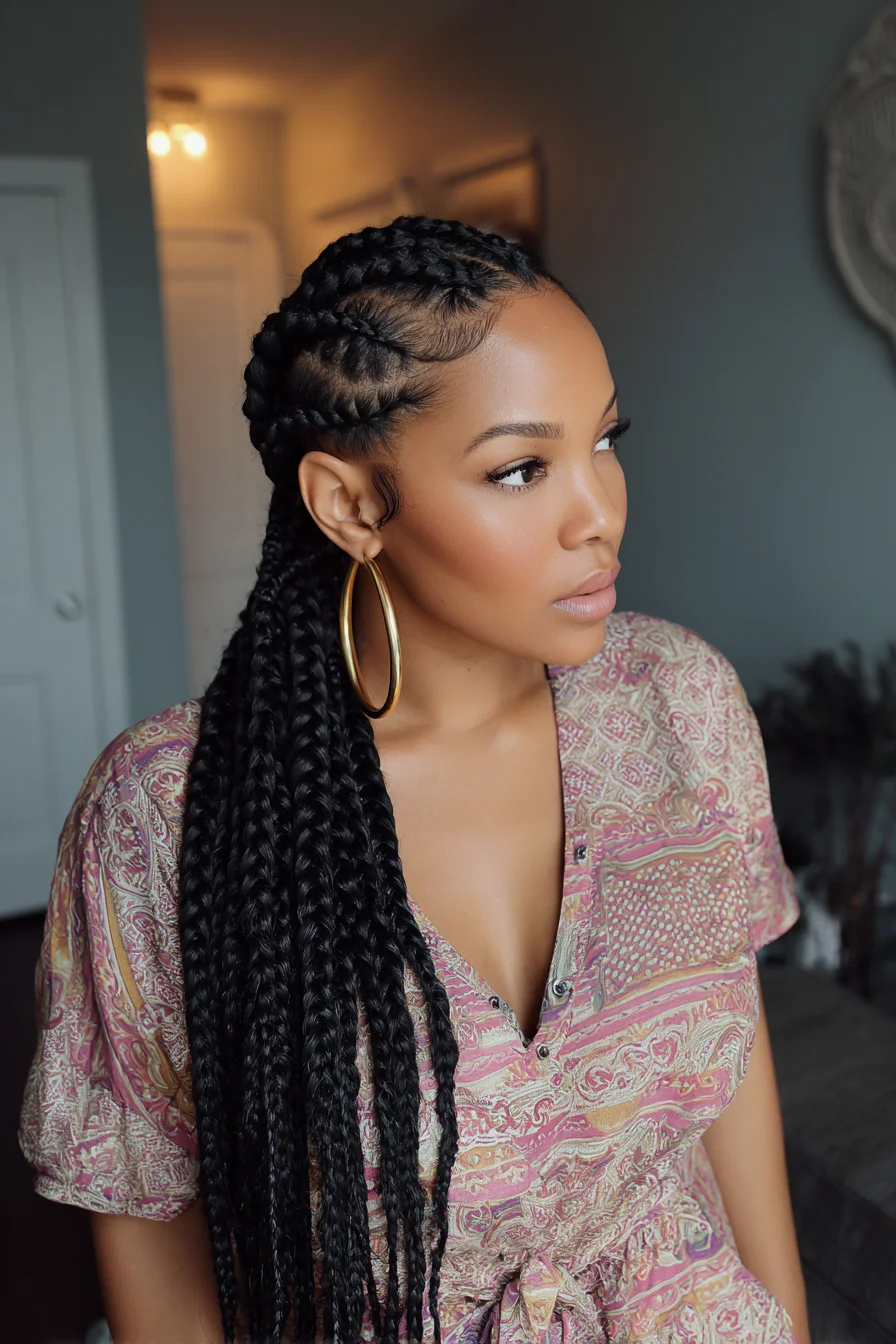
This style suits natural textures from 3A to 4C and is ideal for anyone wanting protective styling with length — it works equally well on freshly stretched or blown-out hair and with lightweight Kanekalon or human-hair extensions. Technique: create clean, feed-in cornrows beginning at the hairline, gradually adding extension hair to form neat, flat rows that transition into long box braids down the side or back. Tools needed: rat-tail comb, sectioning clips, small elastic bands, a fine edge brush, a good pair of braiding hands (or a stylist), and a blow dryer with nozzle if stretching first. Products required: leave-in conditioner, lightweight braid gel or edge control for smooth parts, anti-frizz mousse, light scalp oil (jojoba or grapeseed), and a satin scarf or bonnet. Difficulty level: intermediate to advanced — expect 3–6 hours depending on size and length; seek a professional for even tension. Maintenance tips: wrap nightly with a satin scarf, refresh edges weekly with edge control, apply scalp oil twice weekly, avoid heavy products that weigh braids down, wash gently when needed, and remove after 6–8 weeks to prevent breakage.
Feed‑in Cornrow Braids with Textured Loose Ends
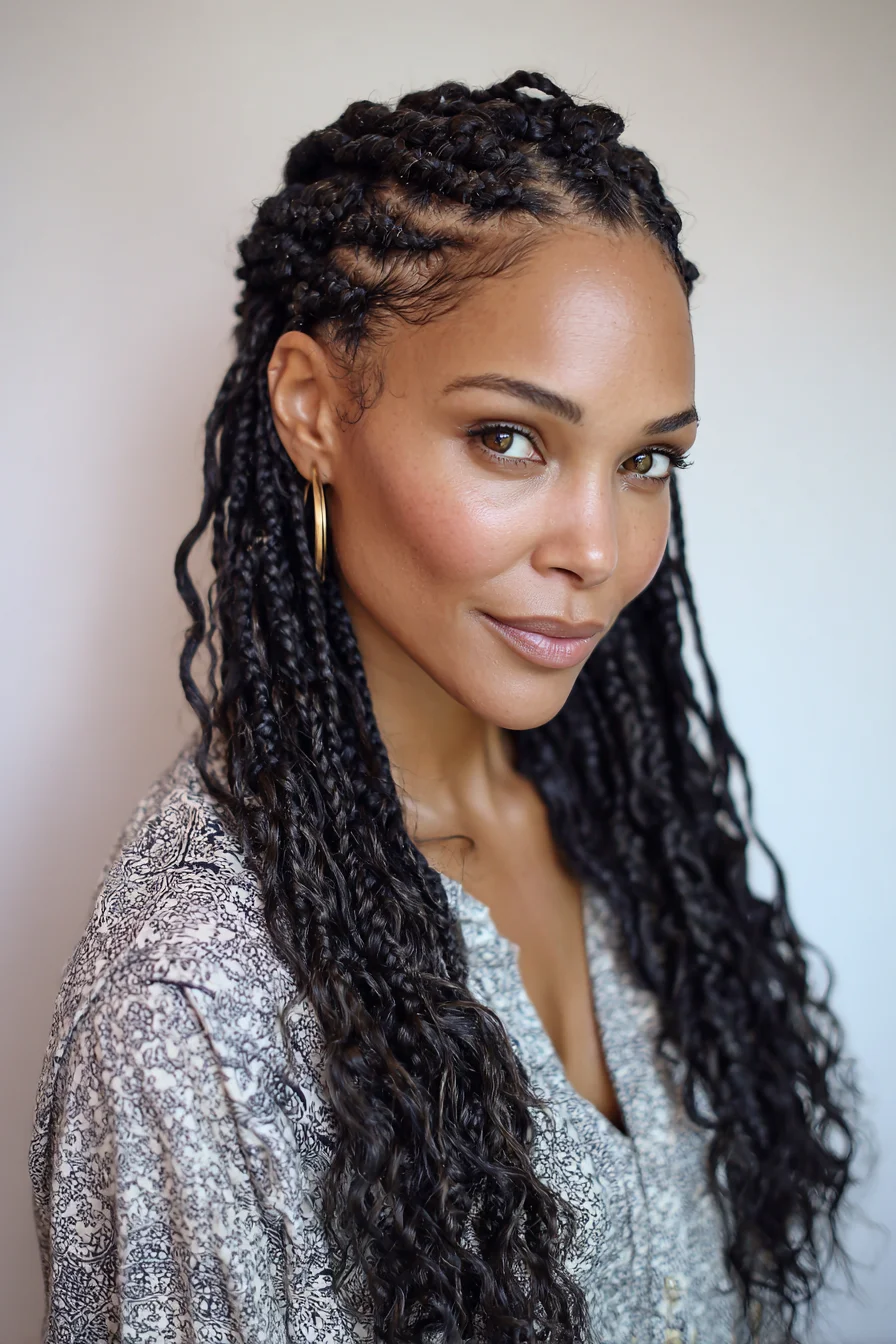
This polished protective style suits natural Type 3–4 hair and medium to thick textures, and can be adapted with added extension hair for fine or shorter hair. Technique: create neat feed‑in or cornrow parts along the scalp, gradually adding hair to build small, secure braids that transition into individual twists or loose textured ends for movement. Tools: rattail comb for parting, sectioning clips, small elastic bands, crochet/latch hook (if using prelooped extensions), and a blow dryer with diffuser for stretch‑drying. Products: clarify and deep condition first, then use a lightweight leave‑in, edge control or gel for smooth parts, a curl cream to define the loose ends, and a light oil or scalp serum for shine and hydration. Difficulty: moderate to high — precise parting and feed‑in technique take practice; expect 3–6 hours in salon depending on size/length. Maintenance: sleep on a satin bonnet or pillowcase, mist roots and ends with water + leave‑in or braid spray, oil the scalp weekly, avoid heavy buildup, refresh edges and touch up front braids every 4–6 weeks, and remove by 8–10 weeks to protect hairline and prevent breakage.
Half-Up Rope Twists with Loose Curly Ends and Honey Highlights
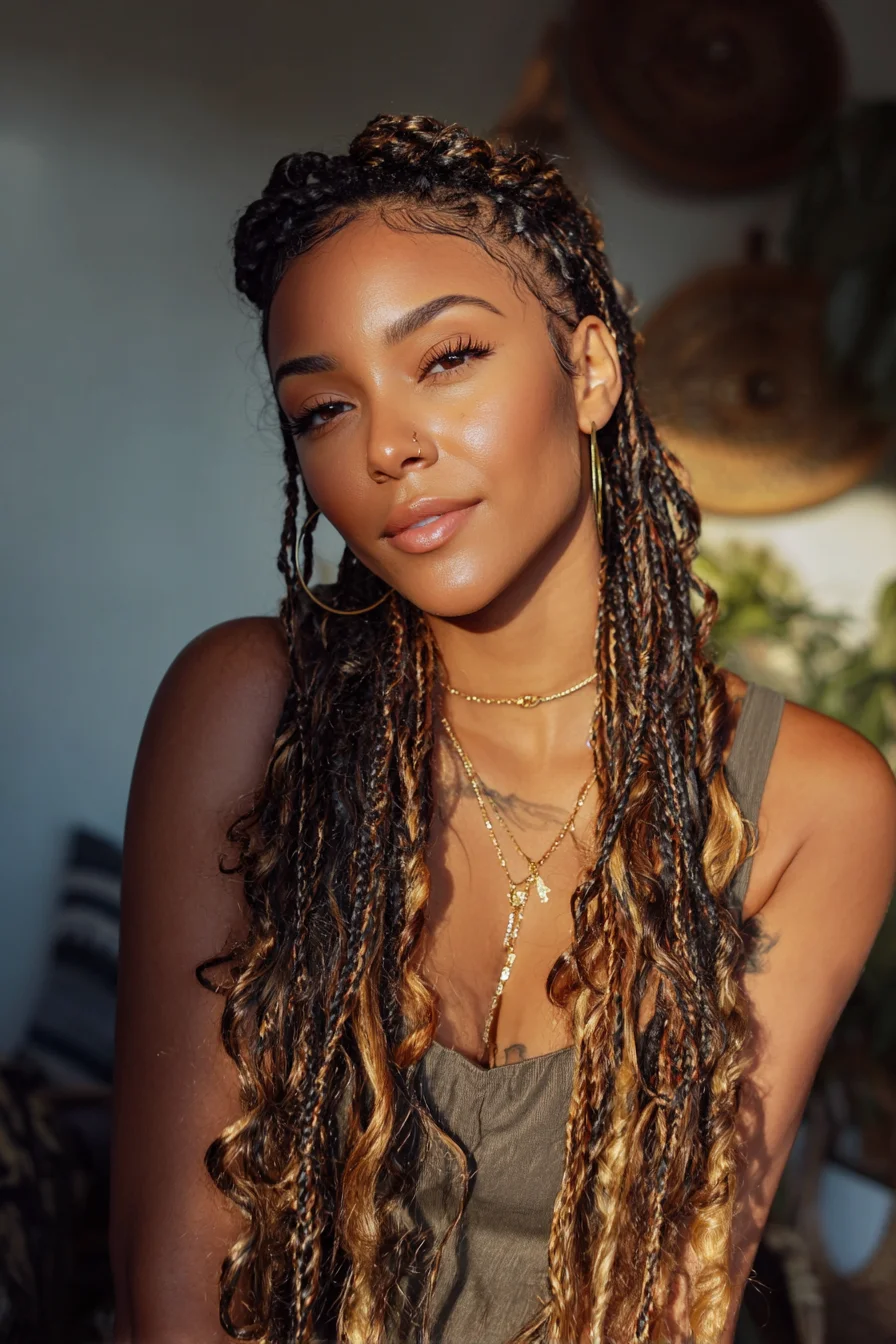
This look suits 3A–4C natural textures and is ideal for medium to thick hair or when using synthetic/natural extensions for added length. Technique: create clean center or side parts, cornrow the top section into a half-up crown, then two-strand rope twist the remaining hair (or feed-in twists) leaving the last 3–4 inches untwisted for soft, curly ends. Pre-colorled or highlighted extensions give the honey-toned dimension without chemical processing. Tools needed: rat-tail comb, long duckbill clips, sectioning clips, crochet needle (optional), hair bands, and a blow-dryer with a diffuser if stretching natural hair. Products required: sulfate-free shampoo, deep conditioner, leave-in conditioner, lightweight braid spray, small-amount edge control, curling mousse or custard for ends, and a light nourishing oil. Difficulty: intermediate — expect 3–6 hours depending on density and length; best done by a stylist for even tension. Maintenance tips: sleep on a silk/satin bonnet, refresh edges and crown every 3–6 weeks, mist scalp and twists twice weekly with braid spray, avoid heavy products to prevent buildup, and plan removal and a deep-conditioning treatment after 8–10 weeks to protect natural hair.
Long Side-Swept Micro Twists with Cornrowed Base and Defined Baby Hairs
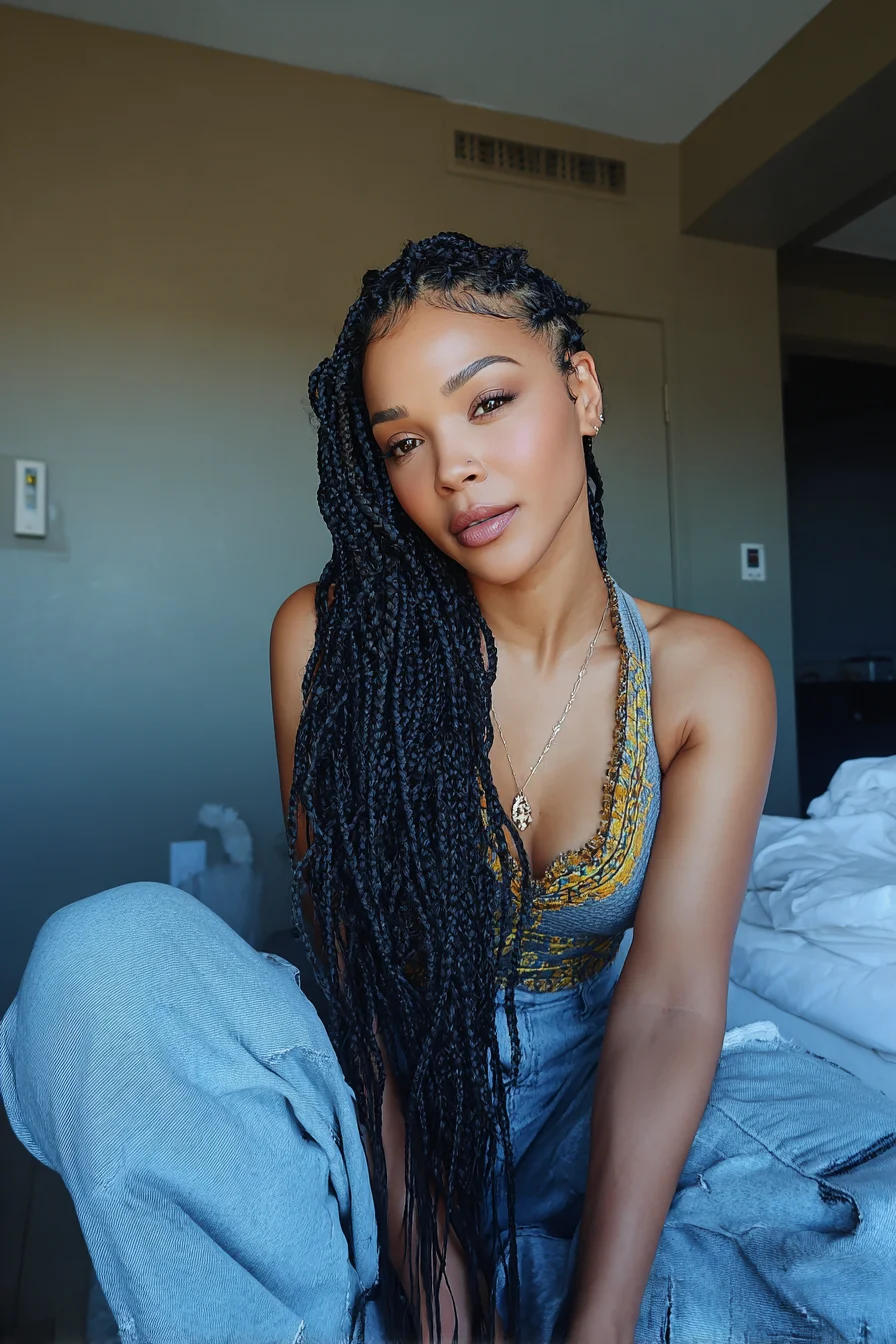
These long side-swept micro twists with a partial cornrow base suit medium to thick natural textures and can work on finer hair when using lightweight extensions. Technique: start on clean, deep-conditioned hair; create small feed-in cornrows along one side for a secure base, then two-strand micro twists down the remaining sections, blending Kanekalon or human hair extensions for length and consistency. Tools: rat-tail comb, sectioning clips, small rubber bands, crochet needle (optional), scissors and a hooded dryer or diffuser for setting. Products: moisturizing leave-in conditioner, light twisting cream, anti-frizz serum, edge-control gel for baby hairs, braid-refresh spray and a lightweight oil for shine. Difficulty: intermediate to advanced — expect 4–8 hours depending on size and length. Salon tip: avoid over-tightening at the roots to reduce tension and risk of breakage. Maintenance: sleep on a silk/satin scarf or bonnet nightly, mist scalp with diluted leave-in or braid spray twice weekly, refresh edges with edge gel as needed, cleanse scalp gently every 2–3 weeks, and remove styles after 6–8 weeks to prevent matting and damage.
Long Beach Waves with Micro Braids and Honey Blonde Highlights
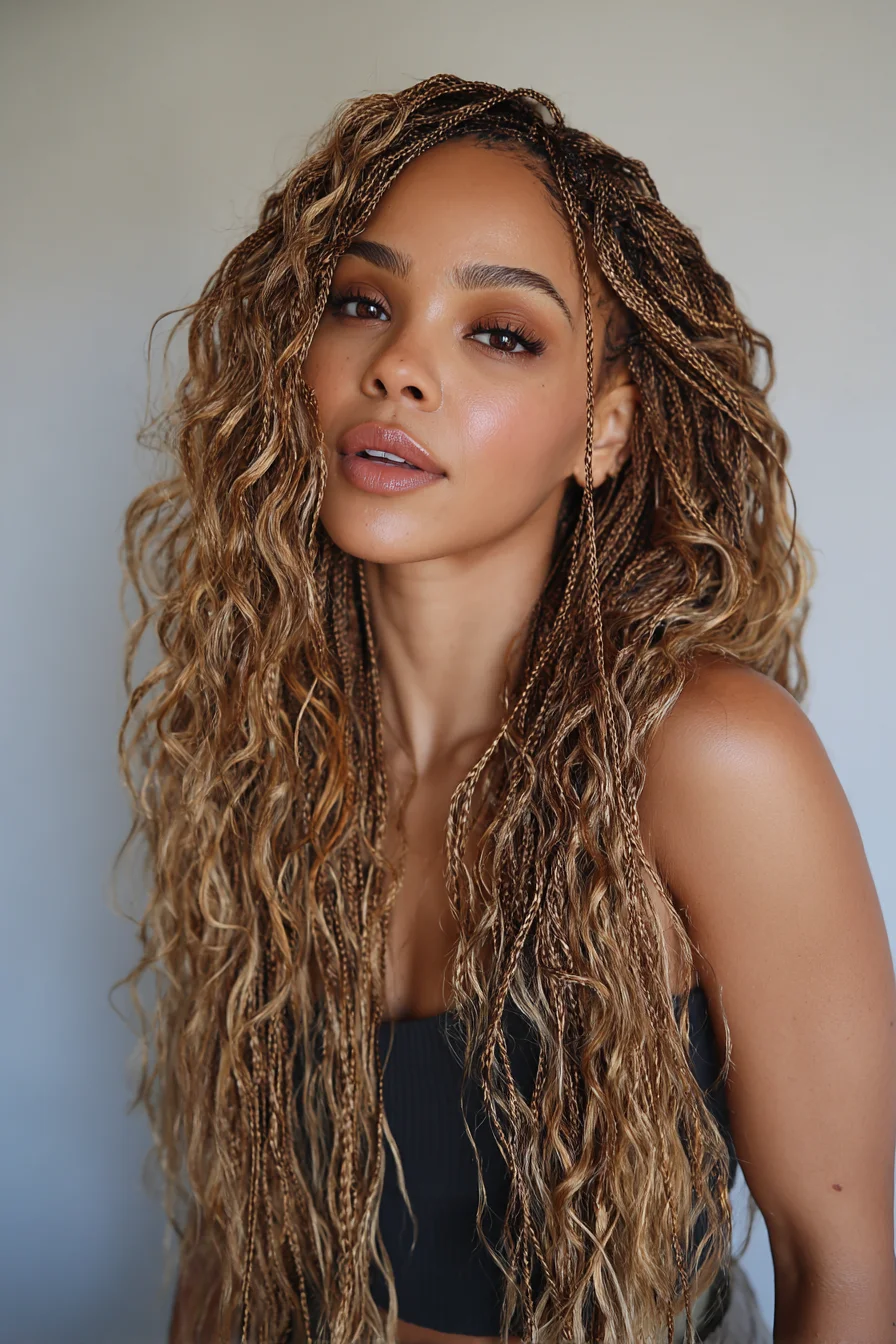
This look pairs small, hand-braided micro braids woven through long, naturally wavy hair with sun-kissed honey-blonde highlights for texture and movement. Suitability: ideal for medium-to-thick hair and naturally wavy to curly textures; fine hair can wear it with added braiding extensions for fullness. Styling technique: section hair and create uniform micro braids close to the scalp or knotless feed-ins, leaving larger sections loose; enhance loose sections with a 1
Long Box Braids with Feed-In Cornrows and Sculpted Baby Hairs
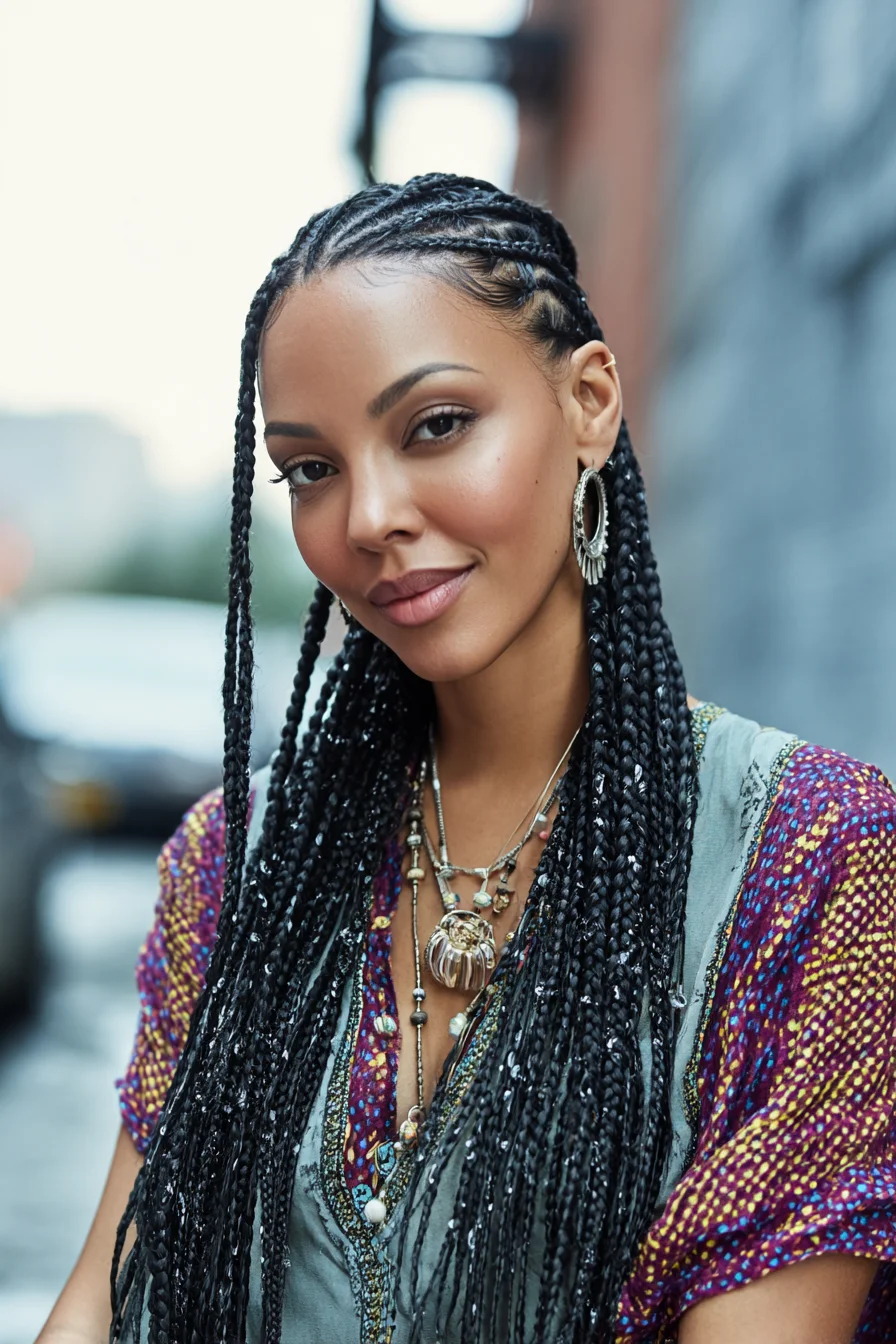
This style suits textured to coily hair types (3A–4C) and can be adapted for finer hair with added extension hair for grip and fullness. The look is created by parting into neat cornrows at the crown using a feed-in technique, then transitioning into long, uniform box braids. For uniform length and reduced tension use pre-stretched synthetic or human hair extensions and feed them in gradually. Tools: rat-tail comb, sectioning clips, small elastic bands, crochet needle (optional), edge brush, and a bowl for hot-water sealing if using synthetic ends. Products: leave-in moisturizing cream, lightweight anti-frizz mousse or foam, edge control gel, scalp oil (jojoba or tea tree blend), and a dry shampoo or diluted cleansing solution for scalp care. Difficulty: intermediate to advanced — expect 4–8 hours depending on braid size and length. Maintenance: moisturize scalp and braids twice weekly with a light spray, sleep on a satin bonnet or pillowcase, retouch edges after 3–4 weeks, cleanse every 2–3 weeks with a diluted shampoo, and remove gently after 8–12 weeks to avoid breakage. Avoid excessive tension on new growth to protect the hairline.
Long Box Braids with Wavy Ends and Half‑Up Top Knot
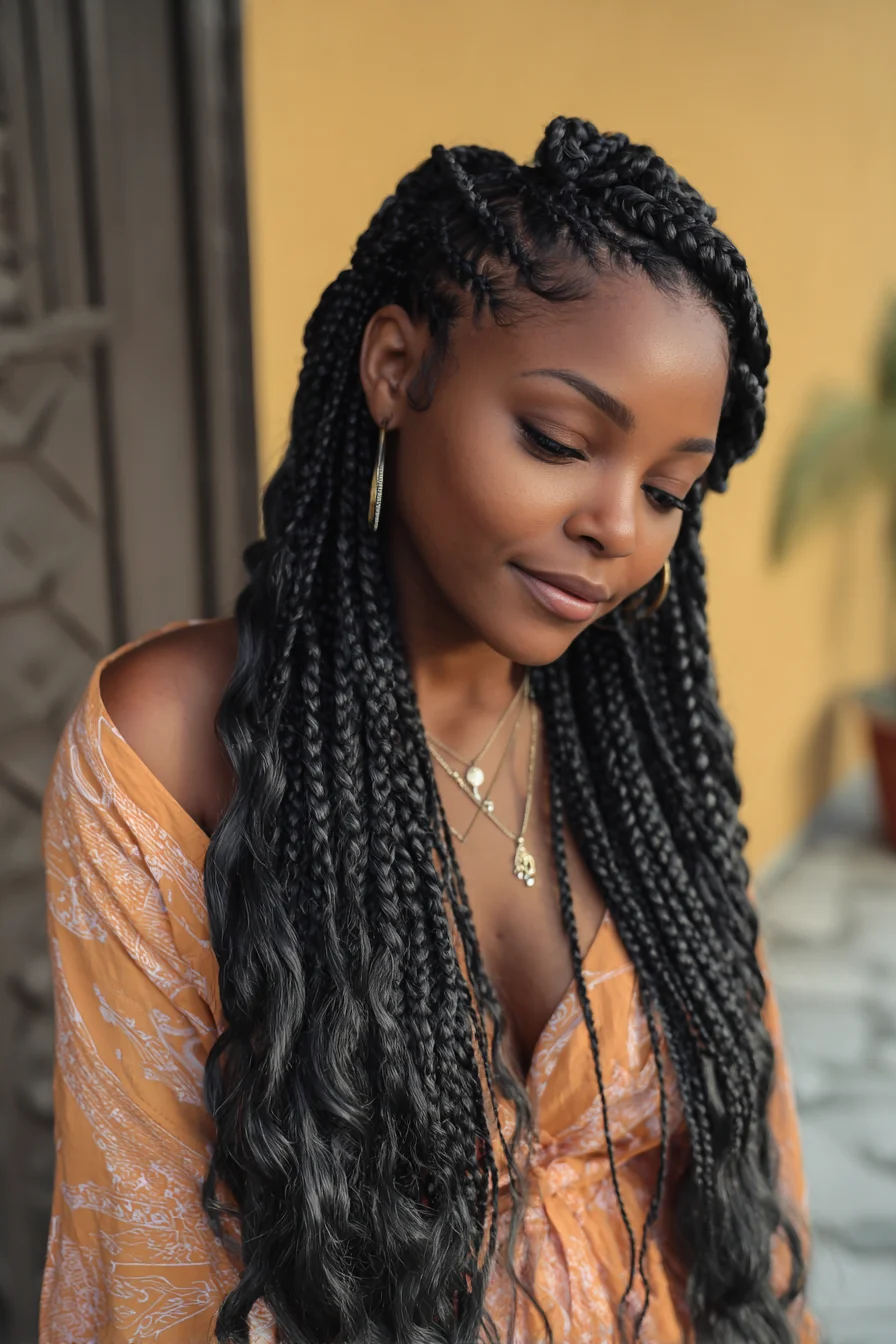
This look suits textured hair (3–4) best but can be achieved on straighter hair with added braiding hair for grip, length, and volume. The style combines small-to-medium box braids with a front cornrow section pulled into a half‑up top knot and soft, wavy loose ends for movement. Technique: create clean square/triangle parts, cornrow the front section toward the crown, then three‑strand braid each box section down to the desired length; add synthetic or human braiding hair where needed for thickness/length. Tools needed: rat‑tail comb, sectioning clips, small elastics, hair clips, optional crochet/loop needle for pre‑braids, and a spray bottle. Recommended products: hydrating leave‑in, lightweight braiding cream or gel for hold, edge control for baby hairs, braid spray or scalp oil, and an alcohol‑free mousse to set ends. Difficulty: moderate to advanced — expect 4–8 hours depending on size and added hair. Maintenance tips: sleep on a satin scarf/bonnet, refresh edges and ends with mousse and edge control, oil the scalp weekly, avoid heavy buildup, and remove or redo after 6–8 weeks to protect edges and hair health.
Half-Up High Top Knot with Long Box Braids — Small to Medium Box Braids

This half-up high top knot with long box braids suits textured, curly, and coily natural hair as well as relaxed or straight hair when using added braiding extensions. Technique: create small-to-medium box-partings, braid with added Kanekalon or premium synthetic hair from the crown back, gather the top half into a high bun/top knot and secure with an elastic and pins while leaving the lower braids loose. Tools needed: rat-tail comb, sectioning clips, braiding hair, elastic band, bobby pins, edge brush, and a crochet needle (optional). Products required: leave-in conditioner, lightweight moisturizing cream, edge control gel, anti-frizz mousse, light hair oil for shine, and a clarifying/scalp spray. Difficulty: intermediate — expect a 3–6 hour salon appointment depending on braid size and length; beginners should book a stylist. Maintenance tips: wrap with a satin scarf or bonnet nightly, cleanse scalp every 1–2 weeks with diluted shampoo or scalp spray, refresh edges with gel and a soft brush, avoid heavy oils at the roots, and remove or redo within 6–8 weeks to prevent tension and breakage.
Long Knotless Box Braids with Purple Ombre and Half‑Up Top Knot
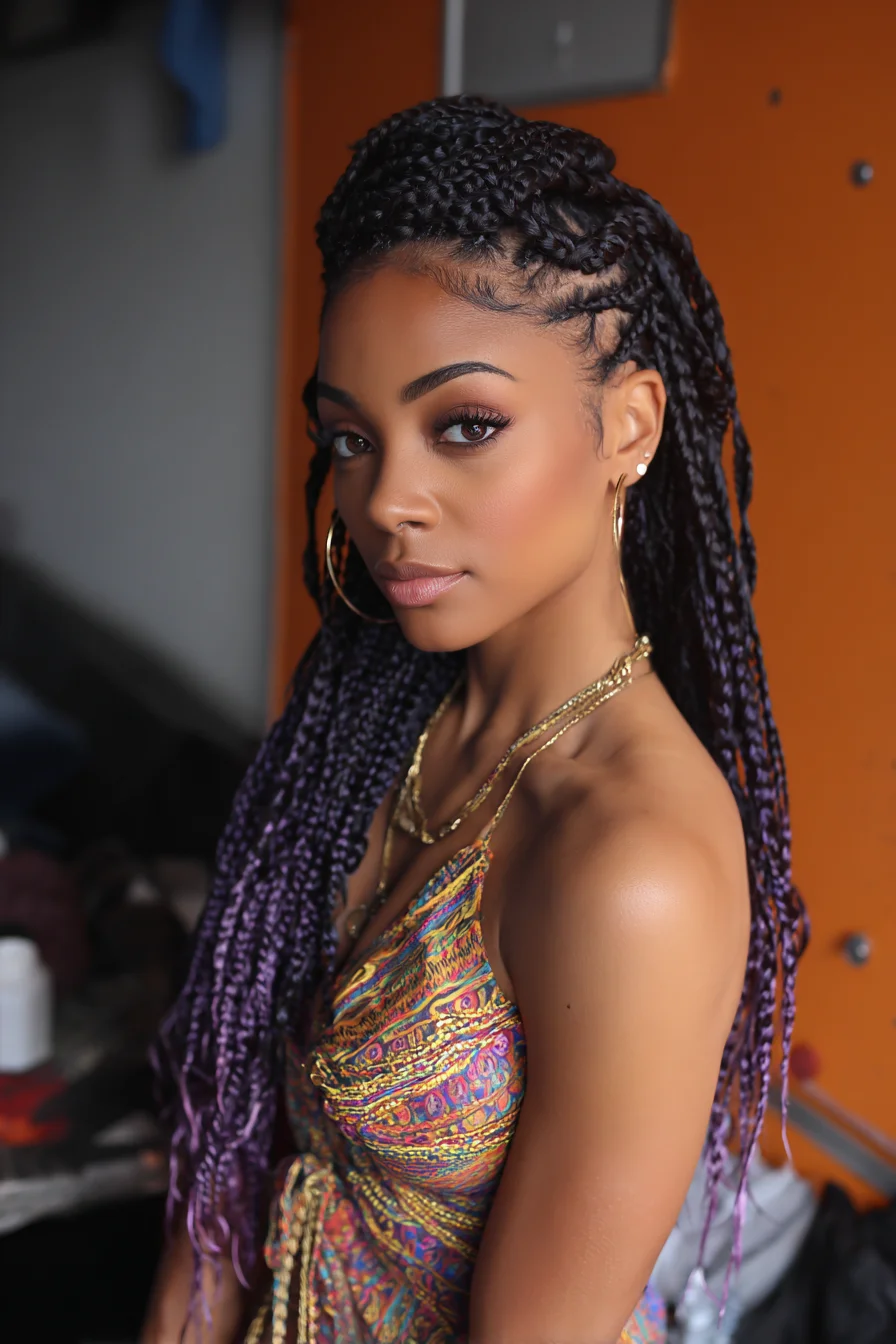
This look features long knotless box braids with a purple ombré finish and a half‑up top knot — a protective, low‑manipulation style ideal for clients who want length, color, and versatility. Hair type suitability: best for Type 3–4 textured hair and medium-to-thick density; fine hair can wear smaller, looser braids to reduce tension. Styling technique: section hair into clean parts, then install knotless (feed‑in) or traditional box braids using pre-stretched braiding hair for a seamless purple ombré; gather the front/top braids into a high half knot while leaving the rest down. Tools needed: rat‑tail comb, sectioning clips, crochet/latch hook (optional), pre-stretched Kanekalon or similar braiding hair, sharp scissors and a blow dryer with tension brush for prep. Products required: moisturizing leave‑in, hydrating cream, edge control gel, light setting mousse to reduce frizz, and a lightweight sealing oil or scalp spray. Difficulty level: intermediate–advanced; expect 4–8 hours depending on braid size. Maintenance tips: sleep on a silk/satin wrap, oil the scalp every 3–5 days, freshen edges and mousse frizz as needed, avoid excessive tension, and remove within 8–12 weeks followed by a deep conditioning treatment.
Side-Swept Long Faux Locs Half-Up with Laid Baby Hairs
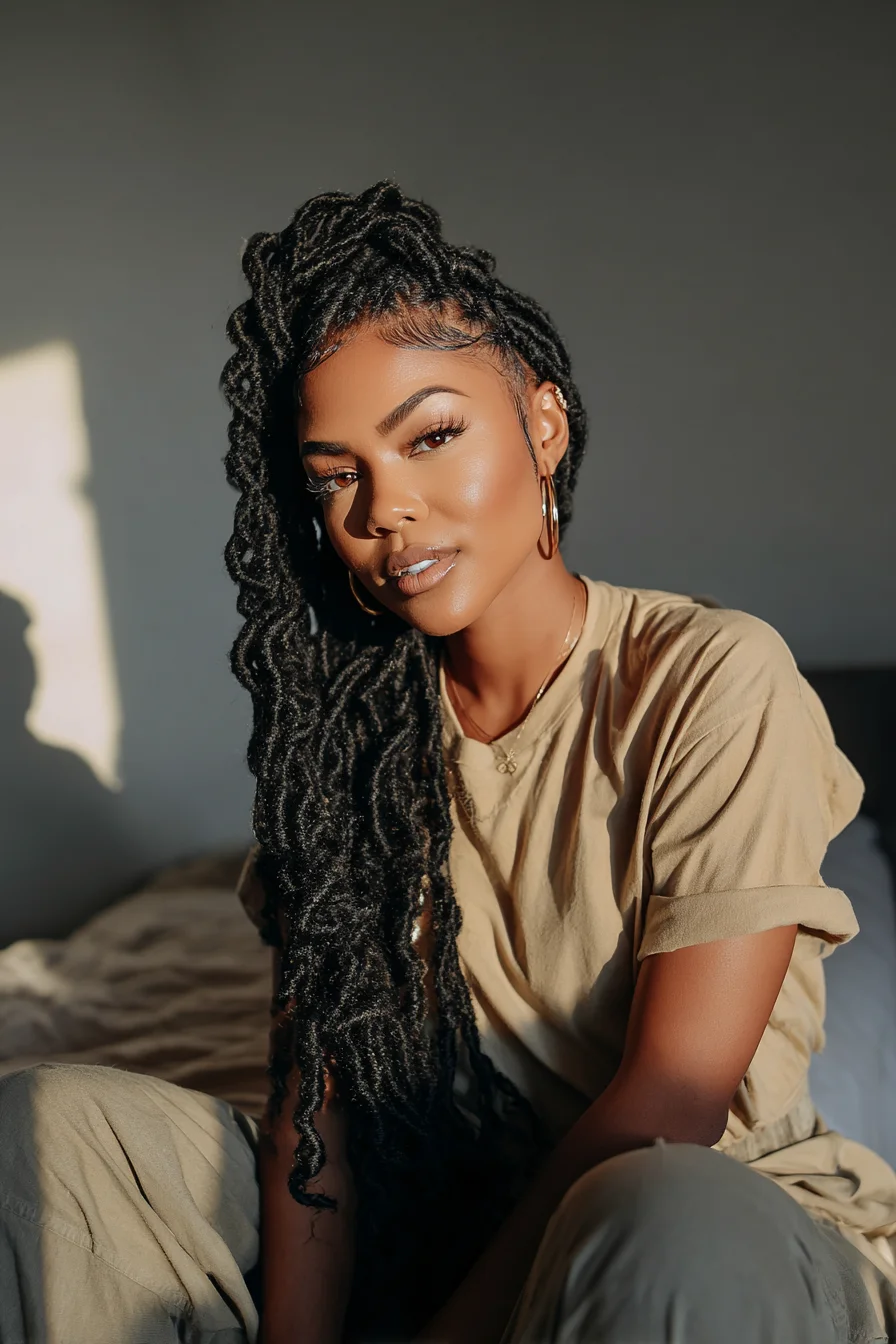
This long side-swept faux locs half-up is ideal for natural, transitioning, or relaxed hair with medium to thick density; fine hair benefits from extensions for extra grip. Using pre-made faux locs or hand-twisted locs already installed, section the top half and gather into a high side pony. Wrap a few locs around the elastic to conceal the base and secure with bobby pins, leaving the remainder cascading over the shoulder. Smooth edges with a small brush and edge-control to lay baby hairs and tame flyaways. Tools: rat-tail comb, sectioning clips, small elastic or strong band, bobby pins, toothbrush/edge brush, and a crochet needle if installing or tightening locs. Products: edge-control gel, lightweight water-based leave-in or moisturizer, locking mousse for frizz control, a light oil for shine, and dry shampoo for scalp refresh. Difficulty: moderate — styling is straightforward but installing or re-twisting locs requires professional skill. Maintenance: moisturize scalp 1–2x weekly, avoid heavy product buildup, retwist roots every 4–8 weeks, sleep on a satin bonnet/pillowcase, and refresh edges and frizz with a small amount of mousse or pomade.
Long Two‑Strand Twist Braids with Cornrowed Crown — Protective Boho Style
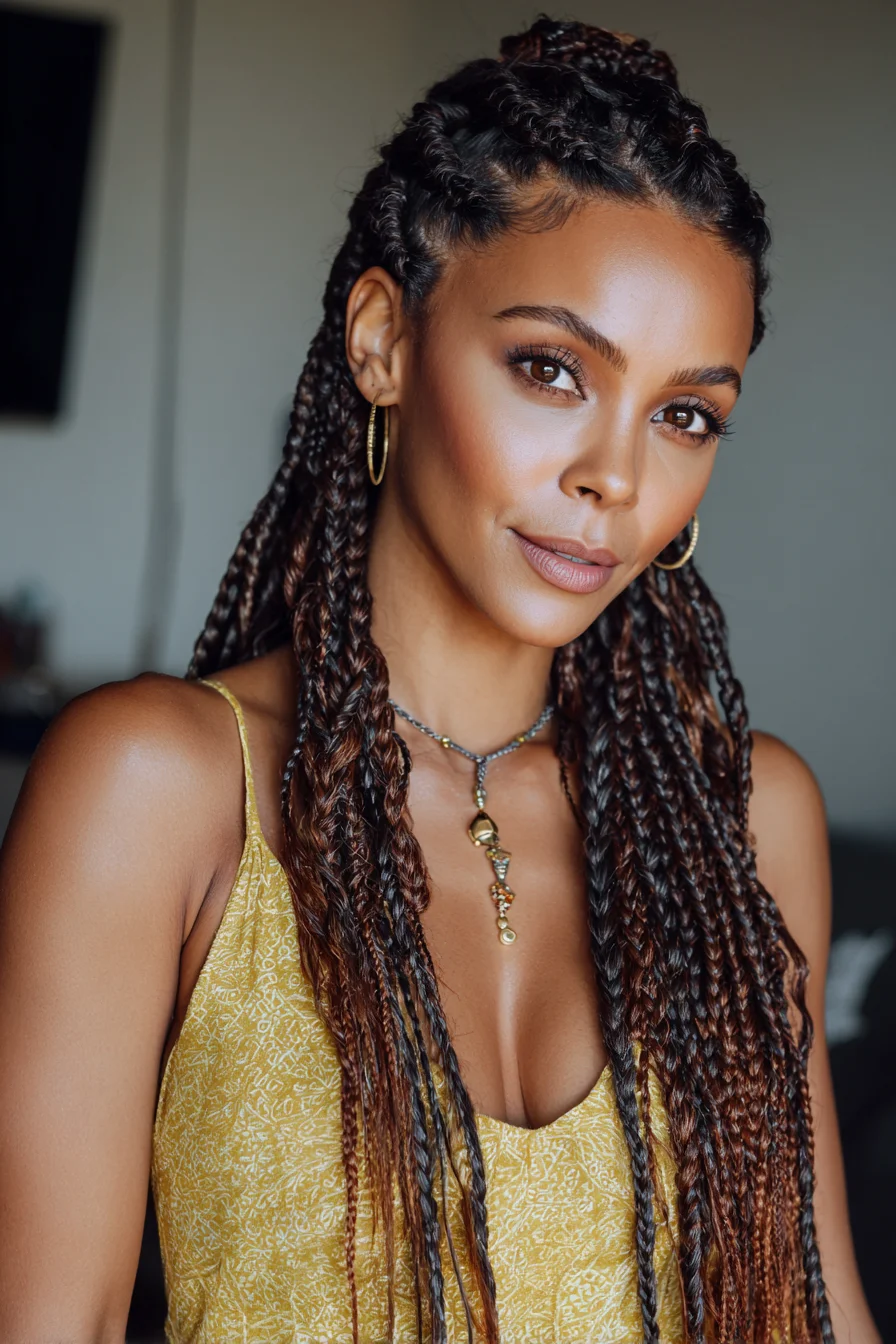
This look pairs small cornrows at the crown with long two‑strand twists or mini braids cascading down for a textured, protective finish. Best suited to medium‑to‑coarse hair (type 3–4), it also works on finer or straight hair when pre‑stretched braiding hair is added for volume and length. Technique: section the top into clean rows and feed or braid the roots into tight cornrows, then transition each section into two‑strand twists or small box braids down the length; finish ends with a soft knot or sealed tips. Tools needed: rat‑tail comb, sectioning clips, fine tooth comb, braiding/kanekalon extensions (optional), small elastics, crochet needle (for extensions), hand towel. Products required: leave‑in conditioner, light styling gel or edge control for the perimeter, braid mousse for hold, light scalp oil or serum, and a shine/spray for finish. Difficulty: moderate to high — 3–8 hours depending on size; salon appointment recommended for first time. Maintenance: sleep with a silk scarf/bonnet, refresh edges weekly, lightly oil the scalp every 7–10 days, cleanse with diluted shampoo or scalp spray, and remove or redo after 6–8 weeks to avoid tension damage.
Long Medium Box Braids — Side-Swept Protective Style
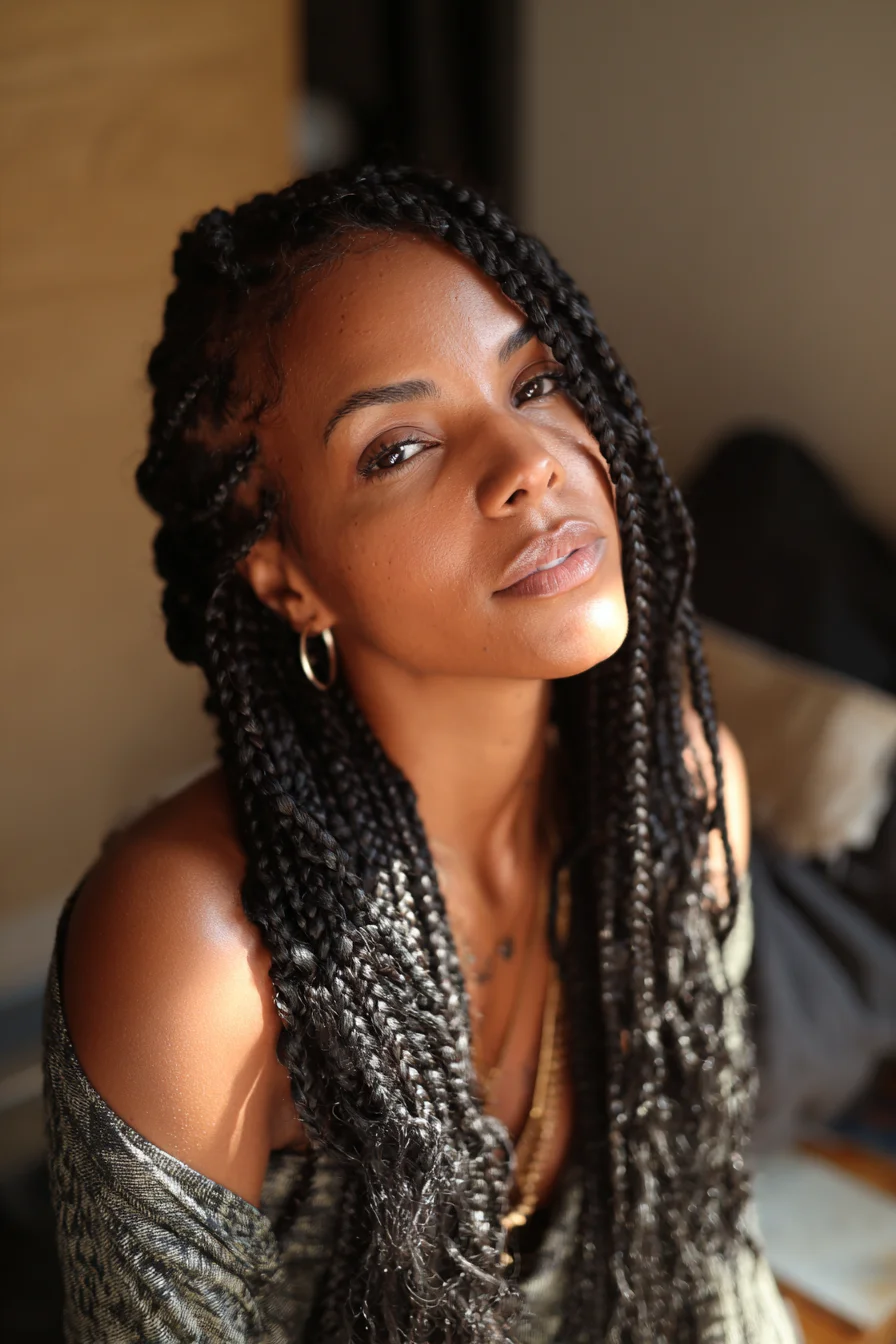
This long, medium-thickness box-braid look is a versatile protective style that suits Type 3–4 natural textures best, but can also be installed on straighter hair using synthetic extensions. Technique: clean, even parting into square sections and either feed-in (invisible) or three-strand braiding with kanekalon or premium synthetic hair produces the neat, uniform braids seen here; start at the scalp and braid to desired length, finishing with heat-sealed or rubber-band ends. Tools needed: rat-tail comb, sectioning clips, braiding hair, edge brush, small elastic bands, scissors and optional crochet needle for pre-braids. Recommended products: a good leave-in detangler, lightweight braid cream or moisturizing spray, edge control gel for smooth hairline, lightweight mousse to reduce frizz, and a non-greasy scalp oil or anti-itch spray. Difficulty level: intermediate to advanced — expect 4–8 hours for a full install; professional installation recommended to control tension and prevent breakage. Maintenance tips: sleep on a silk/satin scarf or pillowcase, moisturize scalp and braid length twice weekly, cleanse scalp with diluted shampoo or braid cleanser, refresh edges as needed, and remove or redo within 6–8 weeks to protect hair health.
Knotless Long Box Braids with Feed‑In Cornrow Roots
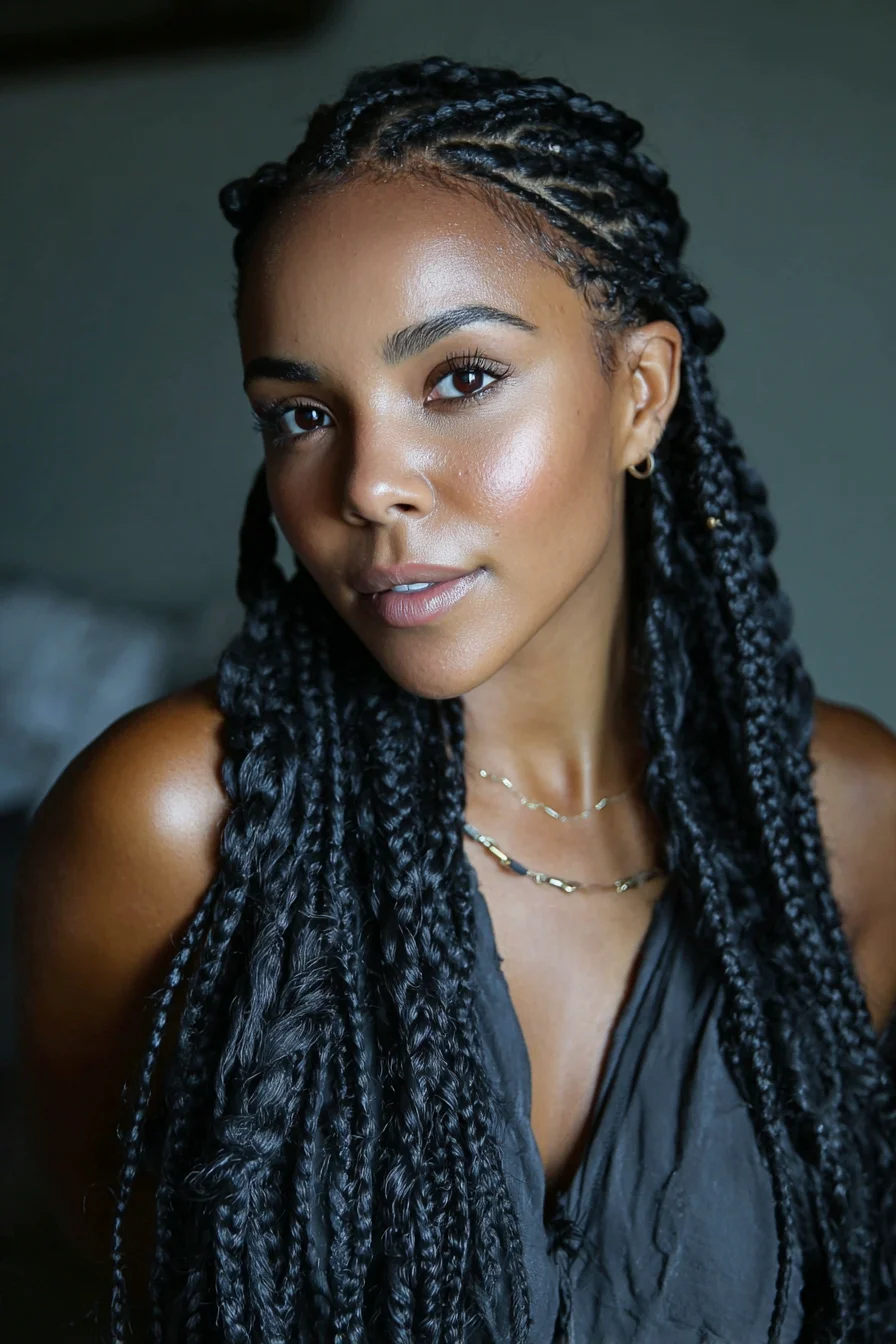
This knotless long box braid style is ideal for Type 3–4 textured hair and anyone looking for a low‑manipulation protective style. The knotless feed‑in method reduces scalp tension, so it’s also suitable for finer or fragile edges when installed correctly. Technique: section the hair into neat cornrow rows, then feed synthetic braiding hair (Kanekalon or premium heat‑resistant fiber) strand by strand to create a seamless, natural root and progressively thicker braid. Finish ends by burning/sealing (for synthetic) or tying and dipping in hot water if appropriate. Tools needed: rattail comb, wide tooth comb, sectioning clips, edge brush, long tail clips, hot water pot (if sealing), and elastic bands. Products required: leave‑in conditioner, lightweight gel or edge control, braid foam or mousse to set, anti‑itch scalp oil (tea tree or jojoba blend), and a braid spray for moisture. Difficulty: intermediate to advanced — expect 4–8 hours depending on length and thickness; professional installation recommended for best tension control. Maintenance tips: wrap with a silk scarf at night, lightly oil scalp weekly, use diluted shampoo or co‑wash monthly, avoid heavy products that weigh braids, and plan for a touch‑up of front rows after 6–8 weeks to preserve edges.
Long Feed‑In Box Braids with Blonde Highlights and Sleek Edges
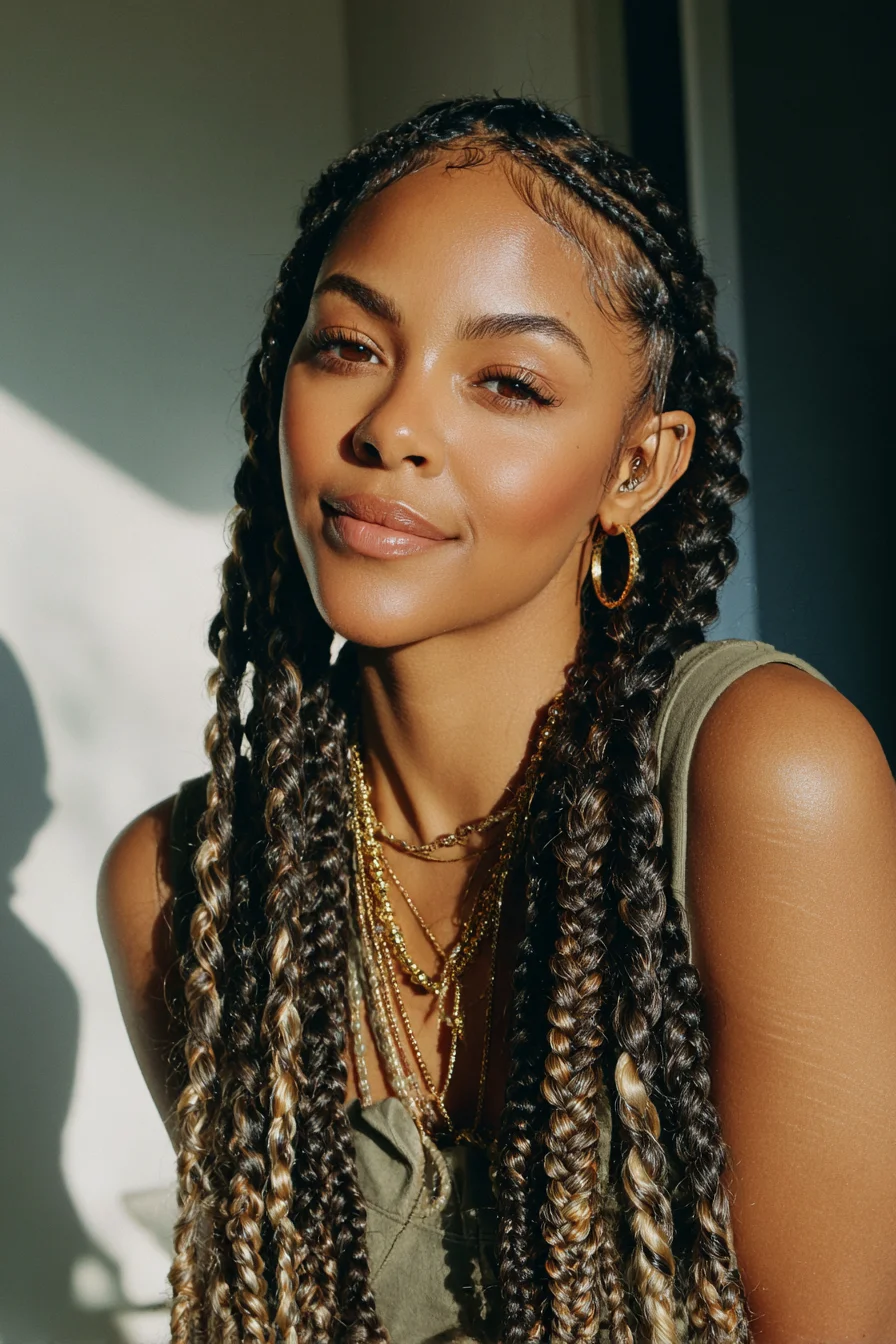
This polished protective style suits medium to coarse textured hair and works well on natural 3–4 hair types or chemically treated hair when strengthened beforehand. Technique: start on clean, detangled hair with a hydrating leave‑in. Section hair into even parts using a rat‑tail comb, then create feed‑in cornrow bases and gradually add synthetic or human extension hair to build long, chunky braids. Finish by laying baby hairs with a soft edge brush for a sleek hairline. Tools needed: rat‑tail comb, sectioning clips, quality kanekalon or human braiding hair in highlight tones, small elastics, edge brush, hair dryer (optional), scissors, and a bowl of hot water to seal synthetic ends if required. Products required: moisturizing leave‑in, lightweight oil (jojoba/argan), anti‑frizz mousse or braid spray, strong but flexible edge control, and a sulfate‑free shampoo for occasional cleansing. Difficulty: moderate to advanced — even tension and neat feed‑ins are easier when done by a trained stylist. Maintenance tips: sleep on a silk/satin scarf or pillowcase, mist scalp with braid spray and oil weekly, refresh edges as needed, avoid excessive tension, and remove or redo after 6–8 weeks to prevent breakage.
Feed‑In Cornrows Transitioning to Long Micro Box Braids — Protective Style
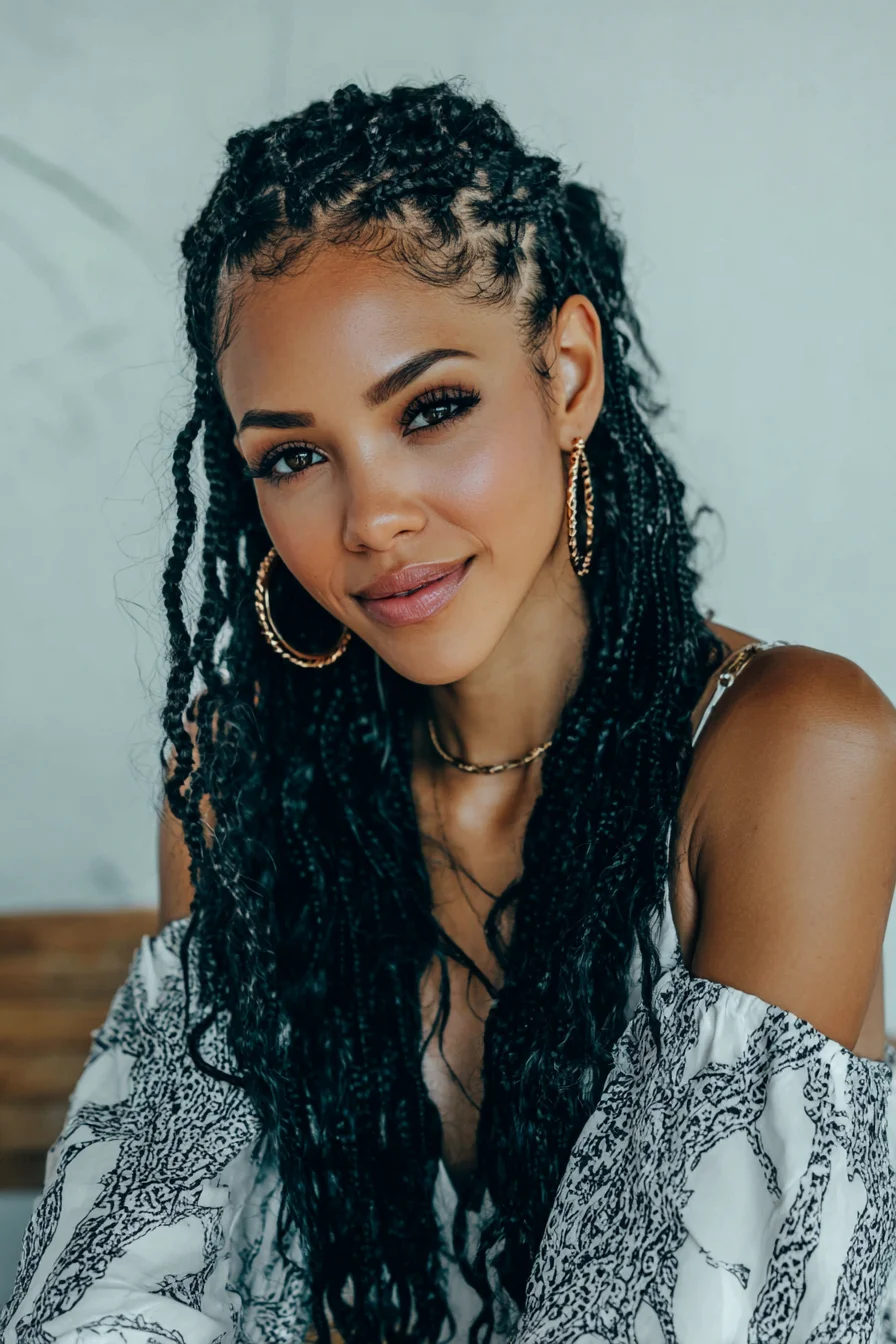
These are feed‑in cornrows at the crown that transition into long, small box/micro braids — a versatile protective style suited to naturally curly to coily textures (type 3–4), or straight hair with added braiding hair. Technique: section the hair into neat rows, create feed‑in cornrows at the front and top to control tension, then continue individual box braids toward the ends, leaving or curling out the hair for softer tips. Salon approach: pre-stretch or blow-dry gently, detangle and apply a lightweight leave‑in before braiding. Tools: rat‑tail comb, hair clips, braiding hair (optional), rubber bands, edge brush, spray bottle. Products: moisturizing leave‑in, lightweight gel or edge control for baby hairs, setting mousse, and a light scalp oil. Difficulty: intermediate — expect 3–6 hours depending on braid size; recommend a professional for micro braids. Maintenance: wrap with a satin scarf nightly, refresh edges with a small amount of gel, moisturize scalp twice weekly with diluted leave‑in or oil, cleanse gently with diluted shampoo or co‑wash, and remove after 6–10 weeks to prevent breakage.
Long Feed‑In Box Braids with Soft Wavy Ends
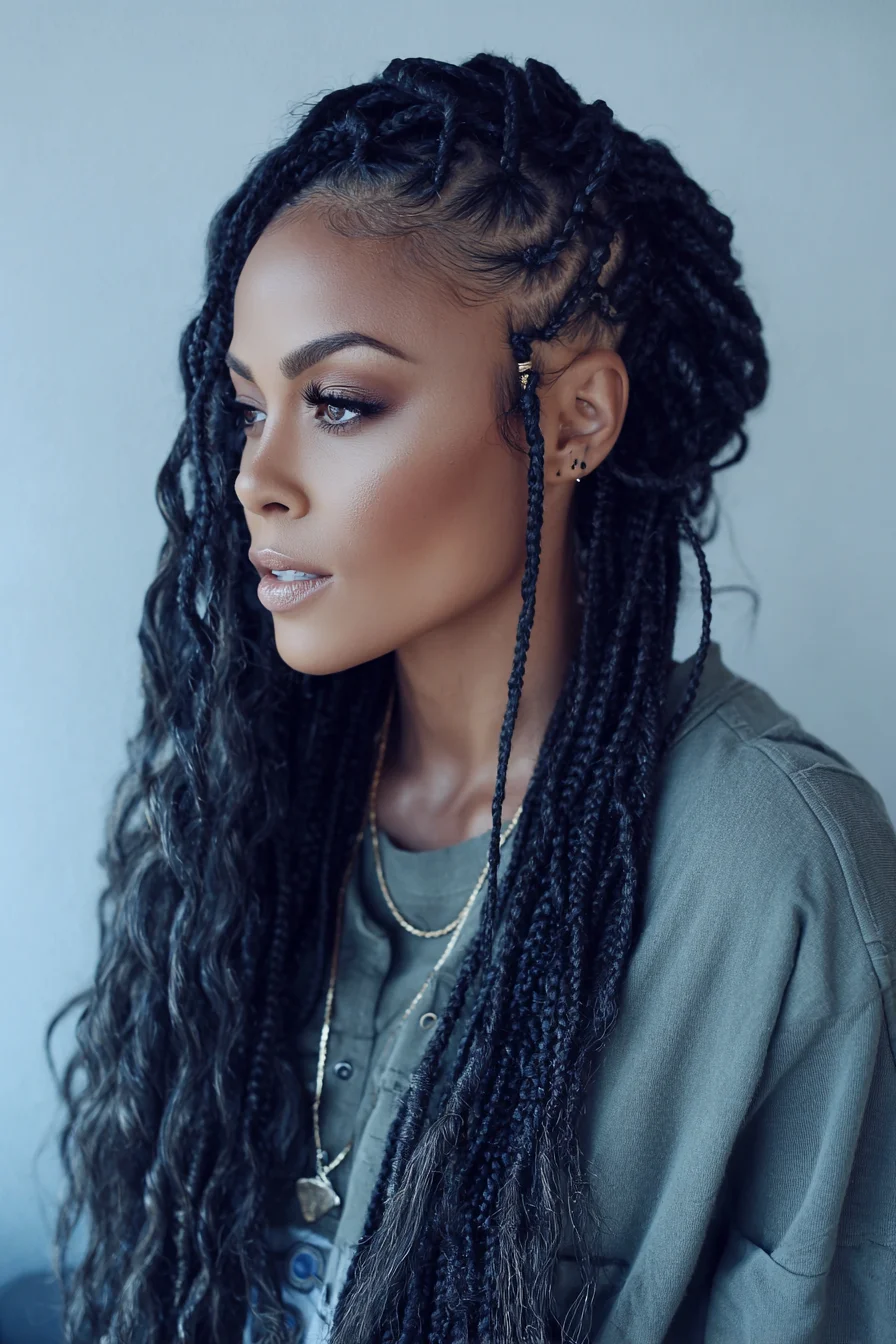
This look suits Type 3–4 natural textures best but can be created on straight hair with pre-stretched or blended extensions. Technique: start on clean, detangled hair; section the crown into feed‑in cornrows to create lifted roots, then transition to individual box braids down the length. For the soft wavy finish leave the last 2–4 inches unbraided or use wavy extension hair and seal ends with a light knot or a small band. Tools needed: rattail comb, sectioning clips, fine‑tooth comb, extension hair (Kanekalon or human blend), small elastic bands, scissors and a crochet needle (optional). Products required: hydrating leave‑in, edge control or gel for smooth parts, lightweight oil or scalp serum, mousse or holding spray to set flyaways and reduce frizz. Difficulty: intermediate — expect 4–8 hours depending on size; precision at the root benefits from a professional. Maintenance tips: sleep on a silk scarf/bonnet, moisturize scalp 2–3 times weekly with light oil, avoid heavy butters that cause buildup, gently cleanse with diluted shampoo or co‑wash, and retouch edges or reinstall braids after 6–8 weeks to prevent breakage.
Chunky Goddess Box Braids with Curly Ends and Blonde Highlights
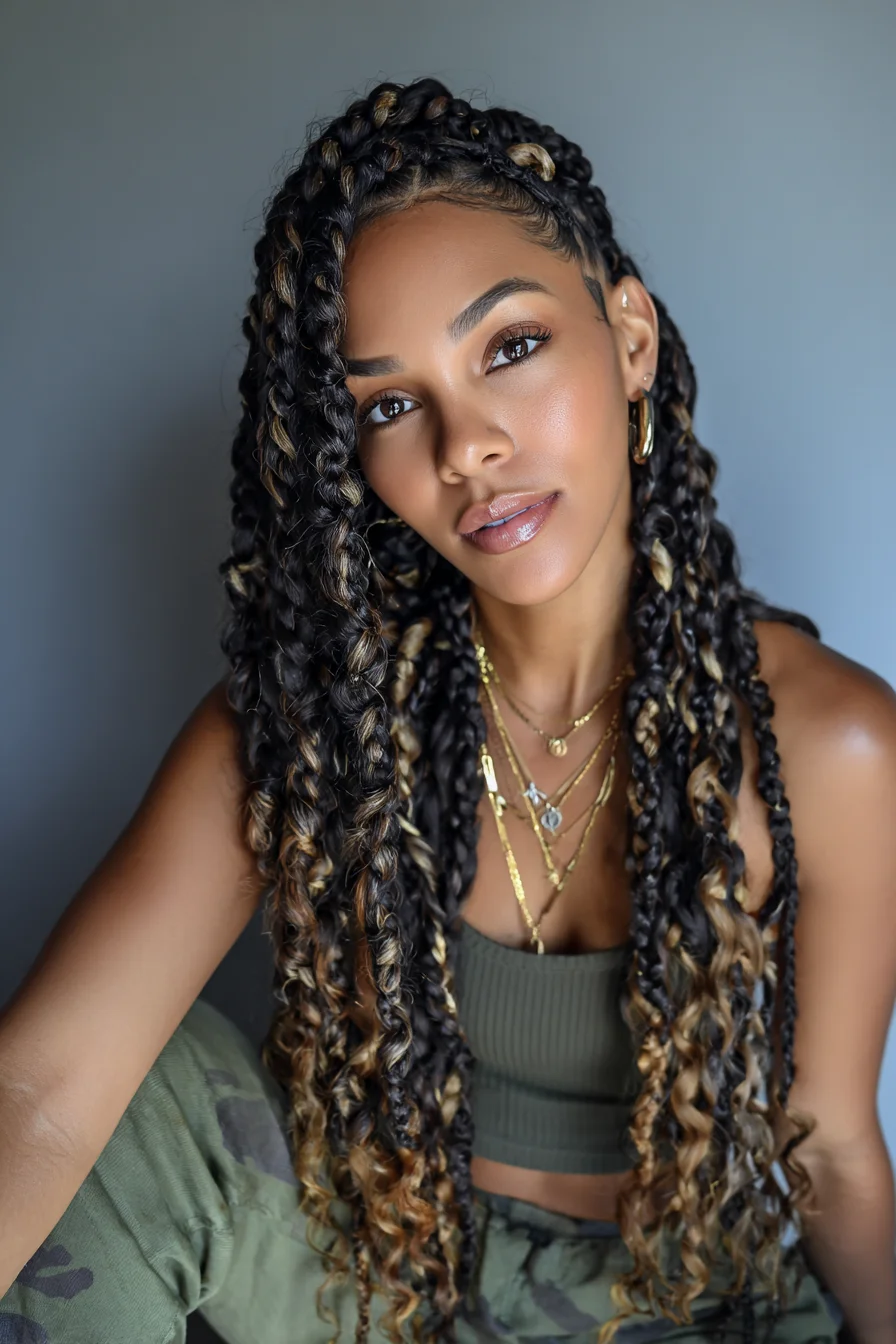
Suitable for type 3–4 textured hair (and fine hair with added extensions), this look combines feed‑in knotless cornrows at the crown with chunky box braids that transition into pre‑curled ends and honey blonde highlights for dimension. Technique: start on freshly washed, detangled hair; section cleanly with a rat‑tail comb, create knotless cornrows along the parting, then feed in synthetic or human hair using the knotless/box method to form large, uniform braids. Finish by installing pre‑curled extension ends or by twisting and dipping synthetic ends in hot water to set the curl. Tools needed: rat‑tail comb, sectioning clips, crochet or latch hook (optional), small elastics, hair cutting shears, bowl for hot water. Products required: leave‑in detangler, edge control gel, lightweight oil or scalp serum, braid mousse or setting spray, and a shine spray. Difficulty: intermediate to advanced — expect 4–8 hours depending on size and length. Maintenance tips: sleep on a silk bonnet, mist weekly with diluted leave‑in or braid spray, oil the scalp to prevent dryness, avoid heavy manipulation, and plan removal around 6–10 weeks to protect natural hair and edges.
Side Feed-In Cornrows with Long Box Braids
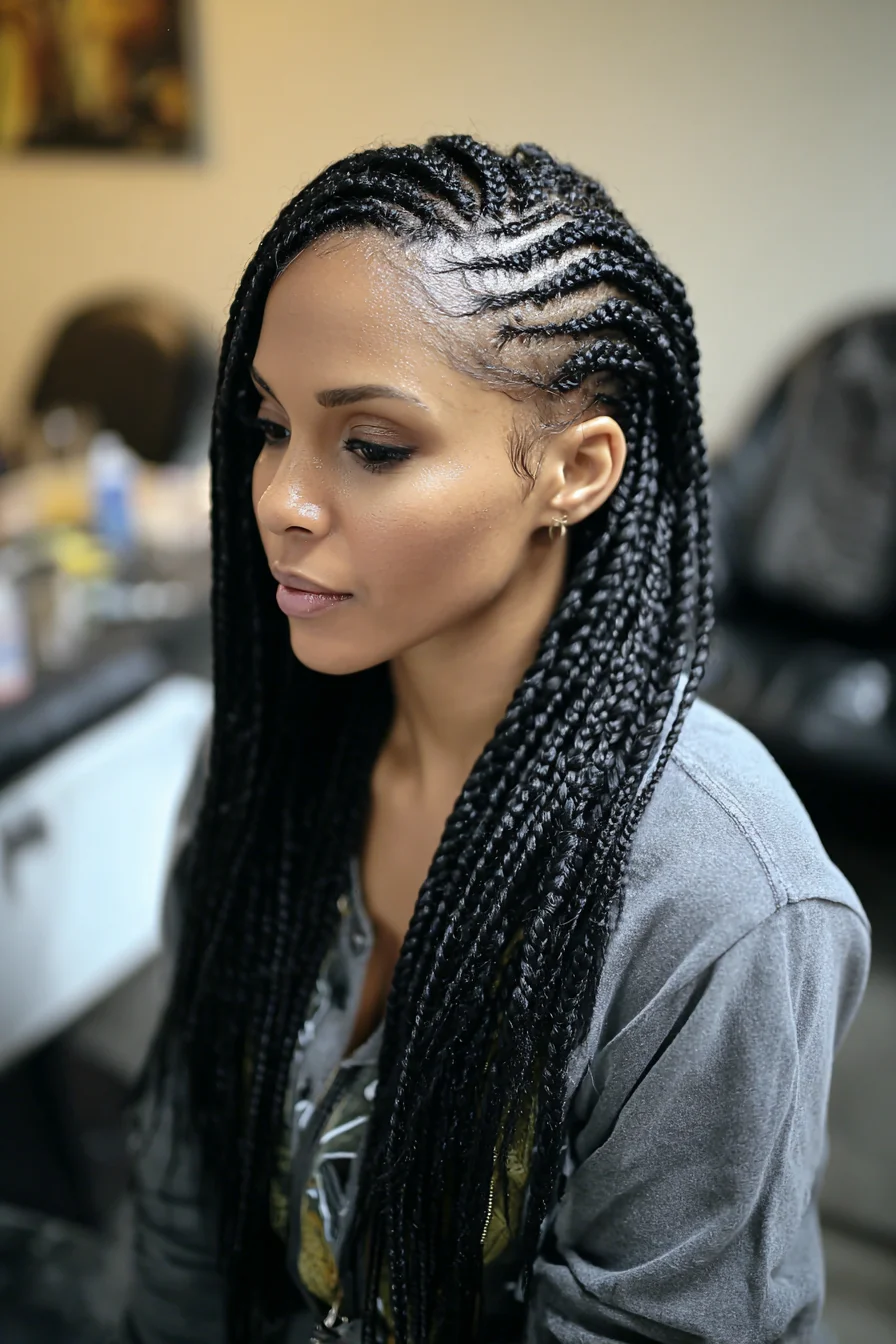
Salon-tested side feed-in cornrows transitioning into long box braids — ideal as a protective style. Suitability: Best for natural 3–4 textures and medium to thick hair; fine hair works well when paired with lightweight kanekalon or human-hair extensions for added density. Styling technique: Start on clean, detangled hair. Use a rat-tail comb to create neat parallel side parts, then braid cornrows using a feed-in method to add extensions gradually and maintain uniform thickness. Continue the feed into individual long box braids and finish ends with small elastic bands or a light seal if using synthetic hair. Tools needed: rat-tail comb, sectioning clips, small elastic bands, edge brush, optional crochet needle and scissors. Products required: lightweight leave-in conditioner, braid gel or edge control for polish, holding mousse to set, anti-frizz spray, and a light scalp oil or serum. Difficulty level: Intermediate to advanced — expect 4–7 hours depending on length and density. Maintenance tips: sleep on satin, apply diluted leave-in or scalp oil weekly, refresh edges sparingly, cleanse scalp gently every 2–3 weeks, and remove or redo within 6–8 weeks to avoid tension and breakage.
Knotless braids are one of my favorite protective styles to recommend because they reduce tension and offer effortless versatility. For long-lasting, healthy results: book a consultation so we can pick the right braid size and extension type for your hair density, avoid overly tight installs, and confirm your desired leave-out or full-install look. Maintain your style by moisturizing the scalp with a light oil or water-based leave-in, cleansing with diluted shampoo or a gentle co-wash every 2–3 weeks, and sleeping on a satin scarf or pillowcase to prevent frizz. Refresh edges with a soft brush and edge control and consider a professional touch-up or removal after 6–8 weeks to protect new growth. If you want help matching a look from the 28 images to your face shape or texture, book an appointment — I’ll tailor the style for your lifestyle and hair health. — Lena